ENGWE vs Fiido: 2026 Model Comparisons, Specs and Prices
·
In this article
ENGWE and Fiido are two China-based direct-to-consumer brands competing in the EU and UK value e-bike segment. ENGWE leans toward heavier folding and fat-tyre builds; Fiido offers more sub-20 kg commuters. Four head-to-head spec comparisons follow.
ENGWE is stronger in heavier folding and fat-tyre builds. Fiido offers more lightweight commuter options and compact urban formats.
At a Glance
- ENGWE: Founded 2014, Shenzhen, China. Known for folding, fat-tyre, and long-range models.
- Fiido: Founded 2017, Shenzhen, China. Known for folding commuters and lightweight urban models. Final assembly in France for select EU orders since April 2025.
- Both: Primarily direct-to-consumer. EN15194 / EAPC compliant for EU and UK (250W, 25 km/h). No broad dealer-service network.
ENGWE vs Fiido brand overview
| Spec | ENGWE | Fiido |
|---|---|---|
| FoundedEst. | 2014, Shenzhen, China | 2017, Shenzhen, China |
| Business modelModel | Primarily DTC | Primarily DTC |
| EU price rangePrice | €599 to €1,999 | €399 to €2,197 |
| Motor typesMotor | Rear hub; selected mid-drive | Rear hub; Mivice on lightweight tier |
| Sensor standardSensor | Torque on many; cadence or unspecified on some fat-tyre models | Torque on many; cadence on C11, D3 Pro |
| Typical weightWeight | 15.6 kg to 43.6 kg | 13.75 kg to 37.8 kg |
| EU/UK configConfig | 250W, 25 km/h, EN15194/EAPC | 250W, 25 km/h, EN15194/EAPC |
| WarrantyWarr. | 12 months | 2 years components, 3 years frame |
| Claimed scaleScale | 500,000+ units sold worldwide | 600,000+ riders worldwide |
Fiido's wider lightweight coverage:
- C700: belt-drive step-through, 19.7 kg, €1,699 / £1,545
- D3 Pro: 14-inch folder, 17.3 kg, €399 / £449
- Fiido X: magnesium-frame folder, 19.8 kg, €1,499 / £1,399
Not sure which one fits your route?
Answer a few questions to match e-bikes to your commute distance, terrain and budget across the full index.
The Four Comparisons
EU pricing in the tables, UK pricing in the quick reads.
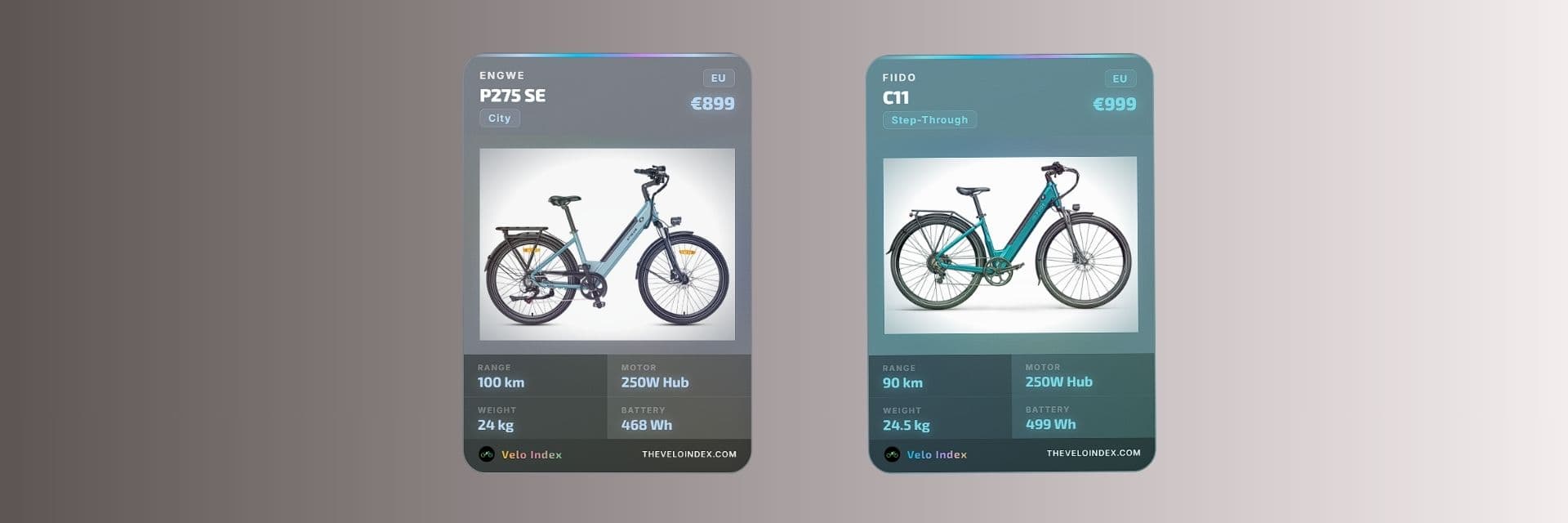
Step-Through Commuter: ENGWE P275 SE vs Fiido C11 Pro
ENGWE P275 SE vs Fiido C11 Pro
Step-through commuter spec comparison (EU)
| Spec | ENGWE P275 SEP275 SE | Fiido C11 ProC11 Pro |
|---|---|---|
| Price (EU)Price | €999 | €1,099 |
| WeightWeight | 24 kg | 24.5 kg |
| MotorMotor | 250W rear hub · 42 Nm | 250W rear hub · 55 Nm |
| BatteryBattery | 468 Wh · Removable | 499 Wh DMEGC/EVE · Removable |
| Range1Range | 100 km | 104 km |
| Pedal sensorSensor | Torque sensor | Torque sensor |
| GearsGears | 7-speed Shimano | 7-speed Shimano |
| BrakesBrakes | Hydraulic disc · 160mm | Hydraulic disc |
| SuspensionSusp. | Front suspension fork | Front suspension |
| Form factorFrame | Step-through (27.5-inch wheel) | Step-through (700C wheel) |
| EU/UK configConfig | 250W, 25 km/h | 250W, 25 km/h |
1 Manufacturer claimed. Real-world range varies by rider weight, terrain, and assist level.
- P275 SE is stronger on: price (€100 lower)
- C11 Pro is stronger on: motor torque (55 Nm vs 42 Nm), battery capacity (499Wh vs 468Wh), claimed range (104 km vs 100 km)
- Same on: torque sensing, weight, gearing, brakes, suspension, frame style
- Entry option: the Fiido C11 uses cadence sensing on the same platform, €899 EU / £908 UK
- UK: £849 (P275 SE) vs £999 (C11 Pro)
EU Step-Through E-Bikes Under €1,500
Accessible step-through frame designs across EU brands, including commuter models from both brands
Folding Commuter: ENGWE P20 vs Fiido D11
ENGWE P20 vs Fiido D11
Folding commuter spec comparison (EU)
| Spec | ENGWE P20P20 | Fiido D11D11 |
|---|---|---|
| Price (EU)Price | €999 | €999 |
| WeightWeight | 18.5 kg | 19.5 kg |
| MotorMotor | 250W rear hub · 42 Nm | 250W rear hub |
| BatteryBattery | 346 Wh Samsung · Removable | 418 Wh DMEGC · Removable |
| Range1Range | 100 km | 86 km |
| Pedal sensorSensor | Torque sensor | Torque sensor |
| GearsGears | Single-speed belt drive | 7-speed Shimano |
| BrakesBrakes | Hydraulic disc | Hydraulic disc |
| SuspensionSusp. | Rigid | Rigid |
| Form factorFrame | Folding (20-inch wheel) | Folding (20-inch wheel) |
| EU/UK configConfig | 250W, 25 km/h | 250W, 25 km/h |
1 Manufacturer claimed. Real-world range varies by rider weight, terrain, and assist level.
- P20 is stronger on: weight, claimed range, belt-drive maintenance simplicity, UK price
- D11 is stronger on: battery capacity and 7-speed gearing for hills
- Same on: EU price, sensor type, brakes, suspension, wheel size, and EU/UK configuration
- Also worth knowing: ENGWE Zip, 16-inch wheels, suspension seatpost, more compact fold, €1,099 EU / £999 UK
- UK: £799 (P20) vs £910 (D11)
EU Affordable Commuters Under €1,000
Budget commuter options across EU brands at accessible price points, including folding models from both brands
Lightweight Urban: ENGWE N1 Air vs Fiido C21
ENGWE N1 Air vs Fiido C21
Lightweight urban spec comparison (EU)
| Spec | ENGWE N1 AirN1 Air | Fiido C21C21 |
|---|---|---|
| Price (EU)Price | €1,249 | €999 |
| WeightWeight | 15.6 kg | 17.5 kg |
| MotorMotor | Mivice M070 250W · 40 Nm | Mivice M080 250W rear hub |
| BatteryBattery | 360 Wh Samsung · Removable | 209 Wh DMEGC · Non-removable |
| Range1Range | 100 km | 100 km |
| Pedal sensorSensor | Torque sensor | Torque sensor |
| GearsGears | 7-speed Shimano | L-TWOO 9-speed |
| BrakesBrakes | Mechanical disc · 160mm | Hydraulic disc |
| SuspensionSusp. | Rigid | Rigid |
| Form factorFrame | Step-over carbon (700C wheel) | Step-over urban/gravel |
| SecuritySmart | GPS, geo-fencing, motion detection | Not specified |
| EU/UK configConfig | 250W, 25 km/h | 250W, 25 km/h |
1 Manufacturer claimed. Real-world range varies by rider weight, terrain, and assist level.
- N1 Air is stronger on: weight (1.9 kg lighter), battery capacity, removable battery design, and built-in GPS security
- C21 is stronger on: price (€250 less), hydraulic brakes, and 9-speed gearing
- Same on: claimed range, torque sensing, step-over frame style, and EU/UK configuration
- Not a perfect mirror match: N1 Air is a carbon urban bike with a removable battery and security features; C21 is an urban/gravel bike with a smaller non-removable battery, hydraulic brakes, and wider gearing
- Also worth knowing: Fiido C700 belt-drive step-through, 19.7 kg with torque sensor, €1,699 EU / £1,545 UK
- UK: £1,199 (N1 Air) vs £999 (C21)
EU Lightweight Commuters Under 20kg
Weight-focused EU comparison including compact and lightweight models from both brands
Fat Tire: ENGWE Engine Pro 2.0 vs Fiido M1 Pro
ENGWE Engine Pro 2.0 vs Fiido M1 Pro
Fat-tyre full-suspension spec comparison (EU)
| Spec | ENGWE Engine Pro 2.0Engine Pro 2.0 | Fiido M1 ProM1 Pro |
|---|---|---|
| Price (EU)Price | €1,399 | €1,099 |
| WeightWeight | 31.6 kg | 26.8 kg |
| MotorMotor | 250W rear hub · 75 Nm | 250W rear hub · 50 Nm |
| BatteryBattery | 768 Wh · Removable | 614 Wh · Removable |
| Range1Range | 110 km | 89 km |
| Pedal sensorSensor | Torque sensor | Torque sensor |
| GearsGears | 8-speed Shimano Altus | 7-speed Shimano |
| SuspensionSusp. | Full (front + rear) | Full suspension |
| BrakesBrakes | Hydraulic disc · 160mm | Hydraulic disc |
| TyresTyres | 20x4.0 fat | 20x4.0 fat |
| Form factorFrame | Folding fat tyre | Folding fat tyre |
| EU/UK configConfig | 250W, 25 km/h | 250W, 25 km/h |
1 Manufacturer claimed. Real-world range varies by rider weight, terrain, and assist level.
- Engine Pro 2.0 is stronger on: motor torque (75 Nm vs 50 Nm), battery capacity (768Wh vs 614Wh), 8-speed gearing, and claimed range
- M1 Pro is stronger on: price (€300 less) and weight (nearly 5 kg lighter)
- Same on: sensor type, suspension type, brakes, tyres, frame format, and EU/UK configuration
- UK: £1,299 (Engine Pro 2.0) vs £999 (M1 Pro)
How to Choose Between Them
Across the four pairings:
- Price: ENGWE is cheaper in one example (P275 SE), Fiido is cheaper in two (C21, M1 Pro), and the P20 / D11 folding pair is tied at €999 in the EU.
- Battery capacity: Fiido has the larger battery in the C11 Pro comparison; ENGWE has the larger battery in the P20, N1 Air, and Engine Pro 2.0 comparisons.
- Claimed range: ENGWE is higher in two pairings (P20, Engine Pro 2.0), Fiido is higher in one (C11 Pro), and N1 Air and C21 are tied at 100 km.
- Warranty: Fiido publishes longer official warranty terms, but both brands remain remote-support purchases rather than dealer-backed purchases.
Prices and specifications checked against the Velo Index dataset: September 2026.
Lean ENGWE if you want:
- Heavier folding, fat-tyre, or long-range builds
- Belt-drive simplicity on the P20
- Built-in GPS security (N1 series, L20 3.0 Pro)
- Lower price in step-through (P275 SE)
Lean Fiido if you want:
- A lightweight commuter (Air 13.75 kg, C21 17.5 kg, D3 Pro 17.3 kg, C700 19.7 kg, Fiido X 19.8 kg)
- Lower weight across more of the commuter range
- Lower price in lightweight urban (C21) and fat tyre (M1 Pro)
Sensor reminder: torque sensing feels more natural; cadence sensing feels more constant. Check at model level. Fiido's C11 and D3 Pro use cadence sensors, while some ENGWE fat-tyre models list cadence sensing or do not specify torque sensing in the current dataset.
Support: both brands handle most support remotely. Neither has a broad dealer-service network. Fiido's France facility supports EU assembly and delivery, but should not be treated as a local service network.
Use the E-Bike Finder to match models to your commute distance, terrain, weight preference, and budget.
FAQs
How do ENGWE and Fiido compare on price? ENGWE's EU range runs from €599 to €1,999; Fiido's runs from €399 to €2,197. Across the four pairs here, ENGWE is cheaper in one, Fiido is cheaper in two, and the P20/D11 folding pair is priced equally at €999.
Are ENGWE and Fiido e-bikes legal in the EU and UK? Yes. EU and UK models use 250W, 25 km/h pedelec configurations under EN15194 and EAPC rules. Both brands also sell separate US ranges under Class 2 and Class 3 standards.
Which brand makes lighter e-bikes? Fiido. Its range includes the Air at 13.75 kg, C21 at 17.5 kg, D3 Pro at 17.3 kg, C700 at 19.7 kg, and Fiido X at 19.8 kg. ENGWE's lightest models are the N1 Air at 15.6 kg, P20 at 18.5 kg, and Zip at 19.4 kg, but most of its range sits above 30 kg.
Do both brands use torque sensors? On many current models, yes. Fiido uses torque sensors on models such as the D11, C11 Pro, C21, Air, Nomads, M1 Pro, C700, and Fiido X. The Fiido C11 and D3 Pro use cadence sensors. ENGWE uses torque sensors on models such as the P275 SE, P20, Zip, N1 series, EP-2 Boost, and L20 3.0 models, while some fat-tyre models list cadence sensing or do not specify torque sensing in the current dataset.
Which brand offers a longer warranty? Fiido publishes longer official warranty terms than ENGWE's listed 12-month coverage. Both brands handle most support remotely, and neither has a broad dealer-service network.
Where are ENGWE and Fiido e-bikes made? Both manufacture in Shenzhen, China. ENGWE through Shenzhen ENGWE Intelligent Technology Co., Ltd.; Fiido through Shenzhen Zhihui Technology Co., Ltd. Fiido also operates a final assembly facility in France for EU orders since April 2025.
Are both brands available across the EU and UK? Yes, both with dedicated EU and UK websites. Both also sell in the United States; Fiido additionally serves Canada.
Compare Models on Velo Index
EU Affordable Commuters Under €1,000
Budget commuter options across EU brands, including folding models from both ENGWE and Fiido
EU Step-Through E-Bikes Under €1,500
Accessible step-through frame designs including commuter models from both brands
For weight-sensitive comparisons: EU Lightweight Commuters Under 20kg. For removable battery designs: EU Urban E-Bikes with Removable Batteries.
The E-Bike Finder matches e-bikes to your commute distance, terrain, and budget across EU, UK, and US markets.
Summary
ENGWE and Fiido compete in the same EU and UK value segment, but their lineups are shaped differently.
- ENGWE is stronger in: heavier folding and fat-tyre builds, higher claimed range in two pairings, lower price in the step-through comparison, and selected GPS-equipped models
- Fiido is stronger in: sub-20 kg commuters, lower weight across more of the range, and lower price in the lightweight urban and fat-tyre comparisons
Across the four matchups: pricing splits 1 ENGWE / 2 Fiido / 1 tie. Battery capacity is category-specific rather than one-sided: Fiido is higher in the C11 Pro comparison, while ENGWE is higher in the P20, N1 Air, and Engine Pro 2.0 comparisons. Claimed range is higher for ENGWE in two pairings and for Fiido in one, while N1 Air and C21 are tied.
The right choice depends on the rider's priority: heavier, longer-range, security-equipped, or fat-tyre models often point toward ENGWE; lower weight and compact commuter formats point toward Fiido.
Velo Index readers can explore the ENGWE EU range at engwe-bikes-eu.com and UK range at engwe-bikes-uk.com (affiliate links, see disclosure). Use code Newengweeu or Newengweuk for 2% off. Fiido's EU and UK ranges: eu.fiido.com and uk.fiido.com.
Related reading:
Image Credit
Product imagery: ENGWE / Fiido.
References
Every model from both brands
The full indexed range for each brand, with specifications sorted for side-by-side comparison.
All Engwe models
Compare all 30 Engwe e-bike models across EU, UK, USA. Full specs for motor, battery, range, weight and price.
All Fiido models
Compare all 13 Fiido e-bike models across EU, UK. Full specs for motor, battery, range, weight and price.