Ride1Up vs Velotric: 2026 Model Comparisons, Specs and Prices
·
In this article
Ride1Up and Velotric are both California-based direct-to-consumer e-bike brands competing in the US mid-range market. Ride1Up covers six distinct categories from $895 to $2,595, including the Brose-powered Prodigy V2 mid-drive and a San Diego showroom. Velotric's 2026 lineup of 17 models spans $1,099 to $2,399 with the VeloCore Discover M mid-drive, SensorSwap technology across most models, and a retail network of over 1,600 partner stores. Their key differences lie in mid-drive motor sourcing, warranty duration, retail access format, and connectivity approach rather than overall price.
Ride1Up and Velotric are direct competitors in the US mid-range e-bike market, targeting overlapping categories at similar price points; their clearest differences are mid-drive motor architecture, warranty terms, and retail access format rather than retail reach.
At a Glance
Ride1Up was founded in 2017 in San Diego and is known for specification depth across a wide price band, a San Diego showroom, and the German-made Brose mid-drive on its Prodigy V2 and TrailRush models. Velotric was founded in 2021 in California by Adam Zhang (hardware co-founder of Lime) and is known for commuter-focused design, SensorSwap technology across most models, and a retail network of over 1,600 partner stores. Both brands manufacture through OEM partners in China, carry UL 2849 and UL 2271 battery certification, and offer two-year warranties on key electrical components.
Ride1Up vs Velotric brand overview
| Spec | Ride1Up | Velotric |
|---|---|---|
| FoundedEst. | 2017, San Diego, California | 2021, California |
| Business modelModel | DTC + San Diego showroom + dealer partners | DTC + 1,600+ retail partner stores |
| US price rangePrice | $895 to $2,595 | $1,099 to $2,399 |
| Motor typesMotor | Rear hub (250W to 750W), Brose TF Sprinter mid-drive | Rear hub (350W to 750W), VeloCore mid-drive |
| Sensor standardSensor | Torque (most models); cadence on Portola, CF Racer1 | Torque or SensorSwap (torque + cadence) on most models |
| ConnectivitySmart | iOS Find My (Vorsa); model-dependent | NFC, Apple Find My, Android Find Hub (2026 models) |
| UL certificationUL | UL 2849, UL 2271 | UL 2849, UL 2271 |
| WarrantyWarr. | Varies by model (Portola: 1 year; others: verify at ride1up.com) | 2 years (frame and key electrical components) |
| Riders / scaleScale | Not disclosed | 150,000+ (January 2026) |
Not sure which one fits your route?
Answer a few questions to match e-bikes to your commute distance, terrain and budget across the full index.
Brand Origins and Distribution
Ride1Up was founded in 2017 in San Diego, California, by Kevin Dugger. The company designs its bikes at its San Diego headquarters and manufactures and assembles them at facilities near Shanghai, China, where it maintains an in-house international quality control team alongside third-party independent inspectors. Ride1Up operates a San Diego showroom at 1851 San Diego Ave, Suite 140, open Monday to Saturday 9:30am to 5:30pm, where riders can test models before purchasing. An authorised dealer network of independent bike shops across the United States provides additional in-person access and repair capability. Ride1Up ships primarily to the continental United States, with Canada available at additional cost.
Velotric was founded in 2021 in California by Adam Zhang, hardware co-founder of Lime, alongside a broader team with experience at Giant, Specialized, and Decathlon. The company designs in California and manufactures through international OEM partnerships. Finished bikes are distributed from US-based warehouses, supporting nationwide shipping within the continental United States. Velotric also distributes through a network of over 1,600 retail partner stores across the United States, with a dedicated Showcase Store tier that stocks the full lineup for test rides. The January 2026 lineup expansion, adding the Discover M mid-drive, Tempo, Summit 2, and GoMad, brought the total model count to 15.
Both brands ship bikes partially assembled and provide assembly guides for the final steps before first ride. Both handle warranty and support through US-based teams. Ride1Up's authorised dealer partners and San Diego showroom add in-person repair and test-ride options; Velotric's 1,600+ retail partner stores and Showcase Store tier provide comparable in-person access across the country, though without a brand-owned flagship showroom. Manufacturing for both relies on OEM partners in China, with Ride1Up's Prodigy V2 and TrailRush using Brose motors manufactured in Germany before final assembly near Shanghai.
You can compare both brands' full US model ranges on Velo Index alongside similar commuter and utility-focused e-bikes.
How the Lineups Compare: Category Overview
Both brands cover the folding, commuter, and cargo-capable categories, with significant overlap between $895 and $2,399. The shape of the two ranges differs in a few notable ways. Ride1Up's range extends into trail eMTB (TrailRush) and ultra-lightweight carbon fiber road riding (CF Racer1), categories Velotric does not cover. Velotric's range extends broader into mountain-hybrid territory (Summit 2) and lightweight urban commuting (Tempo, T1 ST Plus).
The most direct structural difference is in the mid-drive tier. Ride1Up offers the Brose TF Sprinter, a German-manufactured motor used more commonly on European premium e-bikes, across the Prodigy V2 range: the chain variants start at $1,795 (ST, step-through) and $1,895 (XR, step-over), with a Gates belt drive and enviolo CVT available at $2,595. Velotric's VeloCore mid-drive enters at $2,399 (Discover M, step-through only, chain). Both produce 90 to 100 Nm of torque. The Prodigy V2 chain variants are priced below the Discover M; always verify current pricing for both brands before purchasing as promotional pricing may apply.
In the hub-drive commuter and folding categories, the two ranges overlap more closely on price. Ride1Up's Portola folding fat-tire model at $945 and $995 competes with Velotric's Fold 1 Plus at $1,449; both use 750W hub motors but differ on price, battery, and sensor type. In the lightweight category, the Ride1Up Roadster v3 and Velotric Tempo are close in weight, price, and intent, making that pairing the most direct equivalent in the range.
The sections below compare the four categories where both brands have a genuine model entry.
Folding: Ride1Up Portola vs Velotric Fold 1 Plus
The Portola (13.4AH, $995) and the Fold 1 Plus ($1,449) are both folding fat-tire commuters built around a 750W hub motor. The Portola costs $454 less, carries a larger battery at 643Wh compared with the Fold 1 Plus's battery capacity (not published in the current dataset; see footnote), and includes a 150lb-rated rear rack and hydraulic lockout fork at a lower price point. The Fold 1 Plus uses Velotric's SensorSwap system (switchable torque and cadence), while the Portola uses a cadence sensor. Both include a throttle and are Class 1/2/3 switchable.
Ride1Up Portola vs Velotric Fold 1 Plus
Folding fat-tire spec comparison (US)
| Spec | Ride1Up Portola (13.4AH)Portola | Velotric Fold 1 PlusFold 1 Plus |
|---|---|---|
| PricePrice | $995 | $1,449 |
| WeightWeight | 26.76 kg | 28.58 kg |
| MotorMotor | 48V 750W rear hub · 65 Nm | 48V 750W rear hub · 75 Nm |
| BatteryBattery | 643 Wh Reention Rhino UL 2271 · Removable | Not specified2 · Removable |
| Range1Range | 40 miles | 68 miles |
| Pedal sensorSensor | Cadence sensor | Torque + cadence (SensorSwap) |
| GearsGears | 8-speed Shimano Altus | 7-speed Shimano |
| SuspensionSusp. | 80mm fork with hydraulic lockout | 60mm fork with hydraulic lockout |
| BrakesBrakes | Dual-piston hydraulic disc · 180mm | Hydraulic disc · 180mm |
| ThrottleThrottle | Yes | Yes |
| E-bike classClass | Class 1 / 2 / 3 | Class 1 / 2 / 3 |
1 Manufacturer claimed. Real-world range varies by rider weight, terrain, and assist level.
2 Fold 1 Plus battery capacity Wh not confirmed in the current Velo Index dataset. Verify at velotricbike.com before purchasing.
The Portola costs $454 less and is lighter at 26.76 kg vs 28.58 kg, with a larger published battery at 643Wh and an 8-speed drivetrain. The Fold 1 Plus offers a higher-torque motor (75 Nm vs 65 Nm) and SensorSwap for riders who want torque-sensing feel alongside cadence-mode flexibility. The Portola's cadence sensor produces a more constant assist; the Fold 1 Plus's SensorSwap allows both modes. A 10.4AH Portola variant is also available at $945, with a 500Wh battery, for riders whose priority is the lowest possible entry price in this format.
US Folding E-Bikes Under $1,500
Compare folding e-bikes across US brands including the Ride1Up Portola and Velotric Fold 1 Plus
Lightweight: Ride1Up Roadster v3 vs Velotric Tempo
The Roadster v3 (Chain+Susp, $1,495) and the Tempo ($1,499) are the closest equivalents in either range for riders whose priority is low weight and urban commuting efficiency. Both weigh under 18 kg, use 350W to 500W rear hub motors with torque sensors, carry 360 to 374Wh batteries, and are priced within $4 of each other. The Roadster v3 uses a 500W MIVICE angled gear rear hub producing 50 Nm; the Tempo uses a 350W rear hub (650W peak) producing 45 Nm. The Roadster v3 adds a 35mm gravel air suspension fork; the Tempo is rigid.
Ride1Up Roadster v3 vs Velotric Tempo
Lightweight urban spec comparison (US)
| Spec | Ride1Up Roadster v3 (Chain+Susp)Roadster v3 | Velotric TempoTempo |
|---|---|---|
| PricePrice | $1,495 | $1,499 |
| WeightWeight | 18.14 kg | 17.69 kg |
| MotorMotor | 500W MIVICE rear hub · 50 Nm | 350W rear hub (650W peak) · 45 Nm |
| BatteryBattery | 360 Wh Samsung 50GB 21700 · Removable | 374 Wh Samsung/LG 21700 · Removable |
| Range1Range | 40 miles | 60 miles |
| Pedal sensorSensor | Torque sensor | Torque + cadence (SensorSwap) |
| GearsGears | 9-speed microSHIFT Advent | 8-speed Shimano |
| SuspensionSusp. | 35mm Trama gravel air fork | Rigid |
| BrakesBrakes | Tektro HD-R285 2-piston hydraulic disc | Shimano hydraulic disc · 180mm |
| Smart featuresSmart | UL 2849, UL 2271 | NFC unlock, Apple Find My, Android Find Hub |
| ThrottleThrottle | Yes (integrated display) | Yes (removable trigger) |
| E-bike classClass | Class 1 / 2 / 3 | Class 1 / 2 / 3 |
1 Manufacturer claimed. Real-world range varies by rider weight, terrain, and assist level.
The Tempo is 450g lighter (17.69 kg vs 18.14 kg), carries a slightly larger battery (374Wh vs 360Wh), and claims a higher range at 60 miles vs 40 miles. It also adds NFC unlock, Apple Find My, and Android Find Hub tracking. The Roadster v3 counters with a higher continuous motor wattage (500W vs 350W), a 9-speed drivetrain, and the 35mm gravel air fork, which is absent on the Tempo. The Roadster v3 is also available in a belt single-speed configuration at the same price for riders who want maximum drivetrain simplicity. Both include a throttle, though the Roadster v3's is integrated into the VeloFox OLED display rather than a separate trigger.
US Torque Sensor E-Bikes Under $2,000
Natural-feel pedal assist e-bikes under $2,000, including the Ride1Up Roadster v3 and Velotric Tempo
Mid-Drive: Ride1Up Prodigy V2 vs Velotric Discover M
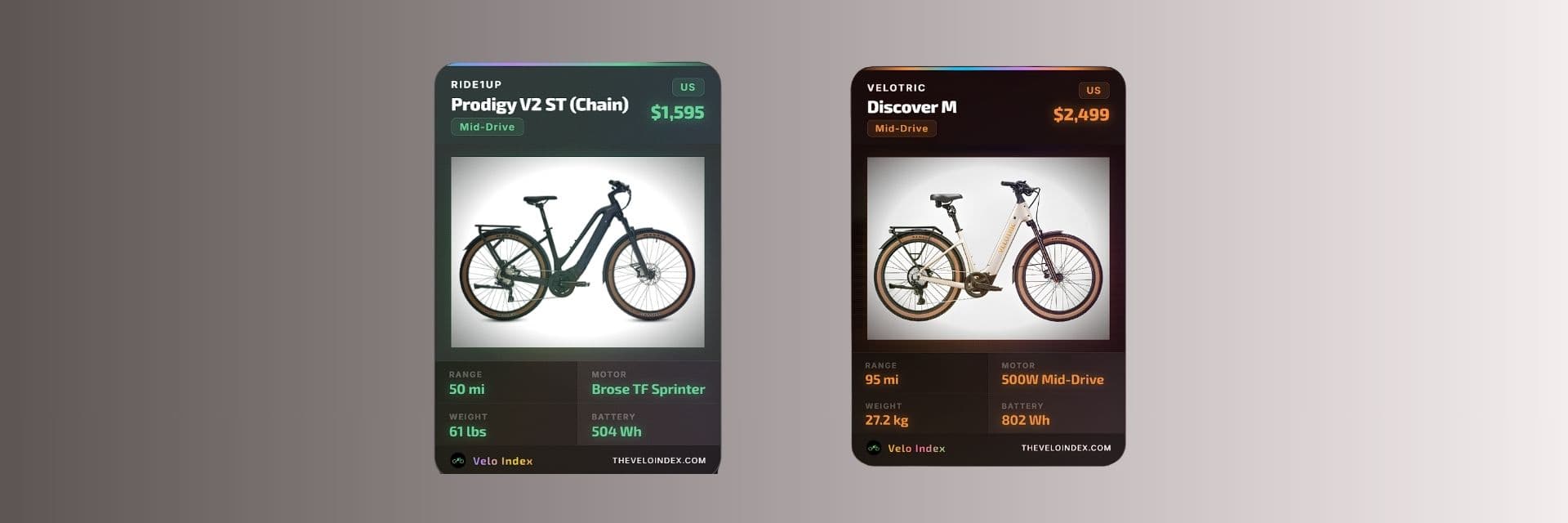
The Prodigy V2 and the Discover M are each brand's mid-drive commuter. Ride1Up offers the Prodigy V2 in two chain configurations, ST (step-through, $1,795) and XR (step-over, $1,895), plus a Gates belt drive with enviolo CVT at $2,595. The Discover M is step-through only at $2,399, chain drivetrain. The table below compares the ST and Discover M as the closest step-through equivalents; the XR shares all specs except frame geometry. The Prodigy V2 uses the Brose TF Sprinter, a German-manufactured motor with 90 Nm torque that appears commonly on European premium e-bikes priced above €3,000. The Discover M uses Velotric's in-house VeloCore 500W mid-drive producing 100 Nm at a higher peak wattage (960W). Both have 100mm-class suspension forks and Tektro hydraulic disc brakes.
Ride1Up Prodigy V2 ST/XR vs Velotric Discover M
Mid-drive commuter spec comparison (US) · ST shown; XR shares all specs, step-over geometry
| Spec | Ride1Up Prodigy V2 ST/XRProdigy V2 | Velotric Discover MDiscover M |
|---|---|---|
| PricePrice | $1,795 ST · $1,895 XR2 | $2,399 |
| WeightWeight | 27.67 kg | 27.22 kg |
| MotorMotor | Brose TF Sprinter mid-drive · 90 Nm (German-made) | VeloCore 500W mid-drive · 960W peak · 100 Nm |
| BatteryBattery | 504 Wh Phylion BN21 Samsung · Removable | 802 Wh Samsung/LG 21700 · Removable |
| Range1Range | 50 miles | 95 miles |
| Pedal sensorSensor | Torque sensor | Torque + cadence (SensorSwap) |
| GearsGears | 9-speed microSHIFT Advent | 9-speed Shimano CUES |
| SuspensionSusp. | 100mm air fork | 80mm air fork + suspension seatpost |
| BrakesBrakes | Tektro HD-M745 hydraulic · 180mm | Tektro hydraulic · 180mm |
| Form factorFrame | ST: step-through · XR: step-over | |
| Smart featuresSmart | Brose display | NFC unlock, Apple Find My, Auto Mode, IMU |
| ThrottleThrottle | No | Yes (removable) |
| E-bike classClass | Class 3 | Class 1 / 2 / 3 |
1 Manufacturer claimed. Real-world range varies by rider weight, terrain, and assist level.
2 Ride1Up prices were checked against the Velo Index dataset in September 2026 and may include promotional discounts. Always verify current pricing for both brands before purchasing. Belt CVT variant available at $2,595.
The Discover M is priced above the Prodigy V2 chain variants and counters with a substantially larger battery (802Wh vs 504Wh), higher claimed range (95 miles vs 50 miles), slightly higher peak torque (100 Nm vs 90 Nm), SensorSwap, an included removable throttle, NFC unlock, and Apple Find My. The Prodigy V2 chain variants counter with a lower entry price, a 100mm fork (vs 80mm on the Discover M), and the Brose motor's established track record in the European premium segment. For riders who want a mid-drive with zero chain maintenance, the Prodigy V2 is also available with a Gates CDX carbon belt drive and enviolo stepless CVT at $2,595, a configuration the Discover M has no equivalent for. The belt CVT variant brings the Prodigy V2 above the Discover M's price while adding a fundamentally different drivetrain proposition.
US Mid-Drive E-Bikes Under $2,500
Mid-drive models across US brands including the Ride1Up Prodigy V2 and Velotric Discover M
Cargo and Utility: Ride1Up Vorsa XR vs Velotric GoMad
The Vorsa XR ($1,495) and the GoMad ($1,999) are both cargo-capable utility builds with integrated racks, large batteries, and suspension forks. The Vorsa XR uses a 750W hub motor producing 95 Nm and carries a 720Wh IPX6-rated battery; the GoMad uses a 750W hub (1300W peak) producing 85 Nm and carries an 802Wh battery. Both use dual torque and cadence sensors (SensorSwap on the GoMad; Ride1Up's Intui-Drive plus R1CBC cadence combo on the Vorsa). Both include iOS and Android device-finding integration.
Ride1Up Vorsa XR vs Velotric GoMad
Cargo and utility spec comparison (US)
| Spec | Ride1Up Vorsa XRVorsa XR | Velotric GoMadGoMad |
|---|---|---|
| PricePrice | $1,495 | $1,999 |
| WeightWeight | 31.75 kg | 34.93 kg |
| MotorMotor | 750W AKM rear hub · 95 Nm | 750W rear hub (1,300W peak) · 85 Nm |
| BatteryBattery | 720 Wh Reention Flamingo Samsung 50GB 21700 · IPX6 · Removable | 802 Wh Samsung/LG 21700 · IPX7 · Removable |
| Range1Range | 60 miles | 75 miles (expandable to 150 miles with second battery) |
| Pedal sensorSensor | Torque + cadence (Intui-Drive + R1CBC) | Torque + cadence (SensorSwap) |
| GearsGears | 8-speed Shimano Acera | 8-speed Shimano |
| SuspensionSusp. | 100mm coil spring fork with hydraulic lockout · thru-axle | 100mm RST hydraulic fork with lockout |
| Rack capacity | 150 lb modular rear rack (iOS Find My integrated) | MIK HD rack integrated with frame · 176 lb rated · bag included |
| Smart featuresSmart | iOS Find My, USB-C charging display | NFC unlock, Apple Find My, Google Find Hub, Stealth mode |
| ThrottleThrottle | Yes | Yes |
| E-bike classClass | Class 1 / 2 / 3 | Class 1 / 2 / 3 |
1 Manufacturer claimed. Real-world range varies by rider weight, terrain, and assist level.
The Vorsa XR costs $504 less and produces higher torque (95 Nm vs 85 Nm) at a lower weight (31.75 kg vs 34.93 kg). The GoMad counters with a larger battery (802Wh vs 720Wh, IPX7 vs IPX6 rated), a higher claimed range, a heavier-rated rack (176 lb vs 150 lb) integrated with the frame, a rack bag included in the box, and a dual-battery expansion path capable of reaching 150 miles per charge. The GoMad's passenger kit is available as an add-on for family riders. Both use combined torque and cadence sensors, both are Class 1/2/3, and both include a throttle.
US Cargo E-Bikes Under $2,500
Cargo-capable models across US brands including the Ride1Up Vorsa and Velotric GoMad
Drivetrain Architecture
The most differentiated element in either brand's lineup is the mid-drive tier. Ride1Up uses the Brose TF Sprinter, a German motor that is torque-sensor-only, produces 90 Nm, and integrates tightly with the frame via Brose's proprietary controller. It has no throttle and is Class 3 only. Velotric's VeloCore mid-drive produces 100 Nm at a 960W peak, includes SensorSwap (switchable torque and cadence), comes with a removable throttle, and is Class 1/2/3 switchable. Both are purpose-built for commuter efficiency on hills, but the Brose motor's European provenance and the VeloCore's broader class flexibility reflect different design priorities.
The Prodigy V2's most distinctive drivetrain option is the Gates CDX carbon belt drive with enviolo stepless CVT, available at $2,595. The enviolo hub provides 380% gear range with continuous, twist-grip adjustment and no cables or derailleur to maintain, one of the lowest-maintenance drivetrain configurations available at this price in the US market. The Discover M has no belt drive option; it uses a 9-speed Shimano CUES chain drivetrain. For riders who place a premium on long-term drivetrain simplicity alongside mid-drive efficiency, the belt CVT Prodigy V2 is the only option in this comparison that delivers both. Velotric uses Shimano chain drivetrains across its hub-drive range and the KMC eGlide chain on the Discover M. In the hub-drive categories, the Roadster v3 is also available in a single-speed belt configuration at $1,395, while neither the Portola nor the Fold 1 Plus offers a belt option.
Sensor Technology and Pedal Assist Feel
Across the four pairings, both brands use torque sensing on most models, but their implementation differs. Ride1Up uses a fixed torque-sensor configuration on the Roadster v3, Vorsa, and Prodigy V2. Velotric uses SensorSwap on most 2026 models (including the Tempo, Discover M, GoMad, Discover 3, and Nomad 2X), which allows the rider to switch between torque-sensing and cadence-sensing modes. The Portola uses a cadence-only sensor, making it one of the two models in these pairings where sensor type is a meaningful differentiator.
Torque sensors measure the force applied to the pedals and adjust motor output proportionally to effort, producing assist that feels natural and responsive. Cadence sensors measure pedal rotation and apply a constant level of assist once triggered, which some riders find easier to manage but less effort-responsive. Neither approach is inherently preferable; the choice depends on riding style and terrain. Velotric's SensorSwap makes this a rider-configurable option on most of its models, rather than a fixed design choice.
Warranty and After-Sales Support
Velotric offers a published two-year limited warranty covering the frame and key electrical components across its range. Ride1Up's warranty terms vary by model: the Portola carries a one-year warranty per the current dataset; terms for other models should be verified directly on the official Ride1Up website before purchasing, as they are not uniformly stated in available specification data.
In-person access is less of a differentiator between these two brands than it might appear. Ride1Up operates a San Diego showroom and an authorised dealer network across the United States for in-person warranty assessment and repair. Velotric's 1,600+ retail partner stores, including a dedicated Showcase Store tier that stocks the full lineup, provide broad nationwide access for test rides and service. Both brands handle most warranty claims through their US-based remote support teams. Ride1Up's own showroom is unique to that brand; Velotric's retail footprint is larger by store count.
Pricing and Value Across the Range
Ride1Up's full US range spans $895 (Portola 02 Lite 10Ah) to $2,595 (Prodigy V2 belt CVT). Velotric's range spans $1,099 (Fold 1 and Fold 1 Lite) to $2,399 (Discover M). In the four pairings compared here, Ride1Up holds the lower price in three (Portola vs Fold 1 Plus, Prodigy V2 chain variants vs Discover M, Vorsa XR vs GoMad); pricing is closest in the lightweight comparison, where the Tempo costs $4 more than the Roadster v3 Chain+Susp.
Note on pricing: Ride1Up prices in this article were checked against the Velo Index dataset in September 2026 and may include promotional discounts. Always verify current pricing for both brands before purchasing.
In the mid-drive category the Prodigy V2 chain variants (ST step-through, XR step-over) are priced below the Discover M at $2,399; the belt CVT variant at $2,595 sits above it. The folding and cargo gaps each favour Ride1Up. These gaps reflect differences in battery size, connectivity features, motor sourcing, and drivetrain architecture rather than a consistent brand-level pricing advantage. Which side delivers more value at a specific price point depends on which specifications the rider prioritises: motor pedigree, drivetrain flexibility including belt CVT, and lower chain-variant entry price (Ride1Up) or battery capacity, SensorSwap, and NFC connectivity (Velotric).
Prices and specifications checked against the Velo Index dataset: September 2026.
Which Category Fits Your Ride?
Choosing between Ride1Up and Velotric often comes down to three practical questions: whether in-person service access matters, which mid-drive motor architecture is a priority, and which category of riding takes precedence.
Ride1Up's structural advantages are mid-drive motor sourcing and its brand-owned San Diego showroom. The Brose TF Sprinter on the Prodigy V2 and TrailRush is one of the few mid-drive options in the US DTC market sourced from a European manufacturer with a long premium track record. The showroom offers a dedicated location for walk-in purchase and test rides in Southern California. For riders who do not need a mid-drive and want a lower price in the folding or cargo categories, the Portola and Vorsa XR are strong choices.
Velotric's advantages are battery capacity, SensorSwap across most models, connectivity, and retail reach. The Discover M's 802Wh battery and 95-mile claimed range exceed the Prodigy V2 ST's 504Wh and 50-mile claim significantly, and the GoMad's dual-battery path to 150 miles is a unique capability in this format. NFC unlock, Apple Find My, and Android Find Hub are standard on the 2026 lineup. With over 1,600 retail partner stores and a Showcase Store tier carrying the full lineup, Velotric also has a wider in-person retail footprint than Ride1Up by store count, which matters for riders who want to test before buying outside California.
For trail and off-road riding, Ride1Up's TrailRush (Brose mid-drive, RockShox fork, Maxxis Minion 29x2.6 tyres, dropper post) has no equivalent in the Velotric lineup. For carbon fiber road riding at ultra-low weight, the Ride1Up CF Racer1 at 12.97 kg also has no Velotric equivalent. These categories are exclusive to Ride1Up's range at current.
The E-Bike Finder can narrow the comparison further by matching both brands' models to your specific commute distance, terrain, and budget.
FAQs
How do Ride1Up and Velotric compare on price? Ride1Up's range runs from $895 (Portola 02 Lite 10Ah) to $2,595 (Prodigy V2 belt CVT); Velotric's runs from $1,099 (Fold 1 and Fold 1 Lite) to $2,399 (Discover M). In the four pairings in this article, Ride1Up is lower-priced in three. In the mid-drive category, the Prodigy V2 chain variants (ST step-through, XR step-over) are priced below the Discover M at $2,399. Ride1Up prices in this article were checked against the Velo Index dataset in September 2026 and may include promotional discounts; always verify at ride1up.com before purchasing. The lightweight pairing is the closest across the four comparisons.
Which brand uses a Brose motor? Ride1Up. The Prodigy V2 range and the TrailRush eMTB use the Brose TF Sprinter mid-drive, manufactured in Germany and rated at 90 Nm. Velotric's mid-drive model, the Discover M introduced in 2026, uses Velotric's own VeloCore 500W platform rated at 100 Nm.
Does Ride1Up have a physical store? Yes. Ride1Up operates a showroom at 1851 San Diego Ave, Suite 140, San Diego, CA 92110, open Monday to Saturday 9:30am to 5:30pm. Velotric does not operate its own brand showroom, but distributes through over 1,600 retail partner stores across the United States, including a Showcase Store tier that stocks the full lineup for test rides.
Do both brands use torque sensors? On most current models, yes. Ride1Up uses torque sensors on the Roadster v3, Vorsa, and Prodigy V2. The Portola uses a cadence sensor. Velotric uses torque sensors across most of its lineup and additionally offers SensorSwap (switchable torque and cadence) on models such as the Discover 3, Nomad 2X, Discover M, Tempo, and GoMad. Sensor type should be confirmed per model before purchasing.
Are both brands available across the US? Yes. Both brands ship to customers across the continental United States from US-based warehouses. Ride1Up also ships to Canada at additional cost. Velotric's primary distribution is the continental United States.
What warranty does each brand offer? Velotric offers a published two-year limited warranty covering the frame and key electrical components. Ride1Up's warranty terms vary by model. The Portola carries a one-year warranty; terms for the Roadster v3, Vorsa, Prodigy V2, and TrailRush should be confirmed at ride1up.com before purchasing.
Compare Models on Velo Index
US Mid-Drive E-Bikes Under $2,500
Mid-drive models across US brands including the Ride1Up Prodigy V2 and Velotric Discover M
US Torque Sensor E-Bikes Under $2,000
Torque-sensor e-bikes under $2,000 including the Ride1Up Roadster v3, Vorsa, and Velotric Tempo
US Folding E-Bikes Under $1,500
Folding e-bikes at accessible price points, including the Ride1Up Portola and comparable models
US Cargo E-Bikes Under $2,500
Cargo e-bikes under $2,500 including the Ride1Up Vorsa XR and comparable US options
USA Affordable Class 3 E-Bikes Under $1,500
Class 3 e-bikes at accessible price points for commuters needing higher assisted speeds
Not sure which one fits your route?
Answer a few questions to match e-bikes to your commute distance, terrain and budget across the full index.
Summary
Ride1Up and Velotric are direct competitors in the US mid-range e-bike market, with significant model overlap across folding, lightweight, mid-drive, and cargo categories. Neither brand holds a categorical advantage across the four pairings in this article. Pricing splits three in Ride1Up's favour with one near-tie; battery capacity and claimed range split in Velotric's favour in three of four pairings. Warranty terms favour Velotric on paper; both brands have substantial in-person retail networks, with Ride1Up offering its own San Diego showroom and Velotric offering 1,600+ retail partner stores by count.
Across the four pairings, the structural differences are clear: Ride1Up's Portola and Vorsa XR are more affordable entry points in the folding and cargo formats; the Brose-powered Prodigy V2 chain variants enter the mid-drive market below the Discover M, with a belt CVT option at $2,595 offering a drivetrain configuration Velotric does not match; and the Roadster v3 is one of the few lightweight torque-sensor gravel commuters in this price range. Velotric counters with larger batteries and higher claimed ranges in most categories, SensorSwap across most models, NFC and Find My connectivity on 2026 bikes, and the GoMad's dual-battery expansion path. For trail eMTB and carbon road riding, Ride1Up's TrailRush and CF Racer1 cover categories Velotric does not currently enter. Note that Ride1Up prices in this article were checked against the Velo Index dataset in September 2026 and may include promotional discounts, always verify at ride1up.com before purchasing.
Velo Index readers can explore the Ride1Up range at ride1up.com (affiliate link, see disclosure).
Velotric readers can use code REF603163 at velotricbike.com for $60 off any order (affiliate link, see disclosure).
Related reading:
All Ride1Up models
Compare every Ride1Up model in the Velo Index database with full specifications side by side.
All Velotric models
Compare every Velotric model in the Velo Index database with full specifications side by side.
Image Credit
Product imagery: Ride1Up / Velotric.
References
Every model from both brands
The full indexed range for each brand, with specifications sorted for side-by-side comparison.
All Ride1Up models
Compare all 20 Ride1Up e-bike models across USA. Full specs for motor, battery, range, weight and price.
All Velotric models
Compare all 20 Velotric e-bike models across CA, USA. Full specs for motor, battery, range, weight and price.