ADO vs Tenways: 2026 Model Comparisons, Specs and Prices
·
In this article
ADO and Tenways are two direct-to-consumer e-bike brands competing for the same EU and UK urban riders. Both build their ranges around torque-sensing assist, carbon belt drives, and hydraulic disc brakes at overlapping price points. The biggest structural difference is drivetrain philosophy: ADO fits Bafang automatic gear-shift hub motors across its Pro and Ultra tiers, while Tenways pairs single-speed hub commuters with a mid-drive AGO range that ADO does not match.
ADO and Tenways are direct competitors in the EU and UK DTC commuter market, and their differences lie in drivetrain architecture, battery capacity, frame formats, and smart features rather than in price or overall market position.
At a Glance
Both brands were founded in 2021 and sell direct to riders across the EU and UK. ADO (A Dece Oasis) is a China-based manufacturer known for folding and commuter models with automatic gear-shift hubs, all running carbon belt drives. Tenways is an Amsterdam-founded brand known for lightweight torque-sensing commuters and a mid-drive trekking range. Both fit torque sensors and hydraulic disc brakes as standard, and both comply with EN15194 and EAPC regulations in these markets.
ADO vs Tenways brand overview
| Spec | ADO | Tenways |
|---|---|---|
| FoundedEst. | 2021, China | 2021, Amsterdam, Netherlands |
| Business modelModel | DTC (EU, UK) | DTC (EU, UK, US) |
| EU price rangePrice | €1,199 to €2,499 | €1,099 to €4,999 |
| Motor typesMotor | 250W rear hub (Bafang, Vinka); Bafang H700/H730 auto-shift hubs | Mivice and TENWAYS rear hub; Bafang, TENWAYS, and Bosch mid-drive |
| Sensor standardSensor | Torque sensor, all models | Torque sensor, all models |
| DrivetrainDrive | Carbon belt drive across the full range | Belt or chain by model; Enviolo CVT on selected models |
| ManufacturingMade | Guangdong Huizhou, China | China, Philippines, Lithuania |
| ComplianceComp. | EN15194 / EAPC (250W, 25 km/h) | EN15194 / EAPC (250W, 25 km/h) |
| WarrantyWarr. | 2 years electrical + 5-year frame (aluminium) | 2 years + 5-year frame |
| RidersRiders | 70,000+ worldwide | Not disclosed |
Brand Origins and Distribution
ADO, short for A Dece Oasis, was founded in 2021 and manufactures its e-bikes through Shenzhen Aodishi Technology Co., Ltd. Production is based at the Guangdong Huizhou Industrial Park, a dedicated facility with a stated annual capacity of 200,000 e-bikes that became operational in May 2025. Finished bikes reach EU and UK riders from a network of overseas warehouses, with after-sales service centres in the UK, Germany, and Poland. The brand reports 70,000+ riders worldwide.
Tenways was also founded in 2021, in Amsterdam. Engineering is based in the Netherlands, with manufacturing and assembly in Guangdong (China), Manila (Philippines), and Ukmerge (Lithuania). The Lithuanian factory gives part of the Tenways range EU-based assembly, which ADO does not offer. Tenways distributes through regional warehouses in the Netherlands, Portugal, and the United States, and now serves the EU, UK, and US markets.
Both brands sell direct to consumer with no traditional dealer network, ship bikes largely pre-assembled, and handle warranty claims remotely through regional support teams. Both fit torque sensors and hydraulic disc brakes on every EU and UK model.
You can compare both brands' full EU and UK ranges on Velo Index using the E-Bike Finder, which filters by commute distance, terrain, budget, and market.
Not sure which one fits your route?
Answer a few questions to match e-bikes to your commute distance, terrain and budget across the full index.
How the Lineups Compare: Category Overview
The two ranges cover similar ground at the commuter core: compact and folding models, step-through city bikes, and premium smart-connected commuters. That is where the direct pairings below sit.
The ranges are shaped differently at the edges. ADO's entire EU and UK lineup runs 250W hub motors with carbon belt drives, and its distinguishing technology is the Bafang automatic gear-shift system used on Pro variants (dual-speed) and Ultra variants (three-speed). Tenways spreads across two architectures: single-speed and 8-speed hub commuters in the CGO series, and a mid-drive AGO range (Bafang, TENWAYS proprietary, and Bosch motors at 75 to 80 Nm) that extends into trekking and touring territory ADO does not enter. Tenways also sells cargo models up to €4,999, against ADO's single Air One cargo platform at €1,999 to €2,099.
The sections below compare the three categories where both brands have a genuine, closely priced entry.
Compact and Folding: ADO Air Carbon vs Tenways CGO Compact
The Air Carbon (€1,999) and CGO Compact (€1,999) are each brand's compact 20-inch belt-drive commuter, priced identically. The Air Carbon uses a carbon-fibre folding frame at 14.5+ kg with a Bafang H730 hub, a 370Wh battery, and built-in GPS anti-theft; the CGO Compact is a 19.8 kg aluminium step-through with the single-speed TENWAYS C9 hub and a larger 500Wh battery. The ADO is fully rigid, while the Tenways adds a suspension seatpost and a MIK-compatible rear carrier.
ADO Air Carbon vs Tenways CGO Compact
Compact commuter spec comparison (EU)
| Spec | ADO Air CarbonAir Carbon | Tenways CGO CompactCGO Compact |
|---|---|---|
| PricePrice | €1,999 | €1,999 |
| WeightWeight | 14.5+ kg | 19.8 kg |
| MotorMotor | Bafang H730 250W brushless DC rear hub · 35 Nm | TENWAYS C9 250W rear hub · 45 Nm |
| BatteryBattery | 370 Wh · Removable | 500 Wh · Removable |
| Range1Range | 100 km (62 miles) | 100 km (62 miles) |
| Pedal sensorSensor | Torque sensor | Torque sensor |
| GearsGears | Single-speed · carbon belt | Single-speed · Gates CDN carbon belt |
| SuspensionSusp. | Rigid | Suspension seatpost |
| BrakesBrakes | Hydraulic disc | TEKTRO hydraulic disc |
| Form factorFrame | Carbon-fibre folding, 20-inch wheels | Step-through compact, 20-inch wheels |
| SecuritySecurity | Built-in GPS anti-theft, battery lock | StVZO-compliant lighting |
| ComplianceClass | EN15194 (250W, 25 km/h) | EN15194 (250W, 25 km/h) |
1 Manufacturer claimed. Real-world range varies by rider weight, terrain, and assist level.
The primary differences are weight and battery capacity, pulling in opposite directions: the Air Carbon is roughly 5 kg lighter, while the CGO Compact carries 130Wh more capacity and the higher torque figure (45 Nm vs 35 Nm) at the same price. Riders who lift the bike onto trains or up stairs, or who want integrated GPS anti-theft, will note the carbon folder; riders who want the largest single-charge capacity, a rear carrier, and seatpost suspension will note the CGO Compact. UK pricing is £1,799 for the Air Carbon; the CGO Compact is listed on the Tenways EU store. ADO also lists the Air Carbon Pro (€2,499) with an automatic dual-speed Bafang H700 and NFC unlock at 16.2 kg. One warranty nuance applies here: ADO covers carbon fibre frames for 24 months against 60 months for its aluminium frames, so the Air Carbon carries shorter frame cover than the five years on the aluminium CGO Compact.
EU Lightweight Commuters Under 20kg
Weight-focused EU comparison including the ADO Air Carbon and multiple Tenways CGO models
Step-Through Commuter: ADO Air 28 Pro vs Tenways CGO800S
The Air 28 Pro (€1,899) and CGO800S (€1,799) are both belt-drive step-through commuters with front suspension, torque sensors, and hydraulic disc brakes, priced €100 apart. The ADO uses a Bafang 250W hub with automatic dual-speed gear-shift and a 346Wh battery; the Tenways uses the single-speed Mivice M070 hub with a larger 461Wh battery. Frame and wheel formats are both full-size (28-inch).
ADO Air 28 Pro vs Tenways CGO800S
Step-through commuter spec comparison (EU)
| Spec | ADO Air 28 ProAir 28 Pro | Tenways CGO800SCGO800S |
|---|---|---|
| PricePrice | €1,899 | €1,799 |
| WeightWeight | 20+ kg | 19 kg |
| MotorMotor | Bafang 250W rear hub with auto gear-shift · 40 Nm | Mivice M070 250W rear hub · 40 Nm |
| BatteryBattery | 346 Wh · Removable | 461 Wh · Removable |
| Range1Range | 100 km (62 miles) | 100 km (62 miles) |
| Pedal sensorSensor | Torque sensor | Torque sensor |
| GearsGears | Automatic dual-speed · carbon belt | Single-speed · Gates CDN carbon belt |
| SuspensionSusp. | Front suspension fork | SR SUNTOUR front suspension |
| BrakesBrakes | Hydraulic disc | TEKTRO hydraulic disc |
| Form factorFrame | Step-through, 28-inch wheels | Step-through, 28-inch wheels |
| SecuritySecurity | Battery lock | StVZO-compliant lighting |
| ComplianceClass | EN15194 (250W, 25 km/h) | EN15194 (250W, 25 km/h) |
1 Manufacturer claimed. Real-world range varies by rider weight, terrain, and assist level.
The primary differences are battery capacity (461Wh vs 346Wh), gearing (automatic dual-speed vs single-speed), and around a kilogram of weight. Riders on flat routes who value the larger battery, lighter build, and lower price will note the CGO800S; riders on undulating routes who want automatic gearing without a mid-drive price will note the Air 28 Pro. UK pricing is £1,599 for the Air 28 Pro and £1,399 for the CGO800S.
EU Urban E-Bikes with Removable Batteries
Removable battery commuters across EU brands, including ADO Air and Tenways CGO step-through models
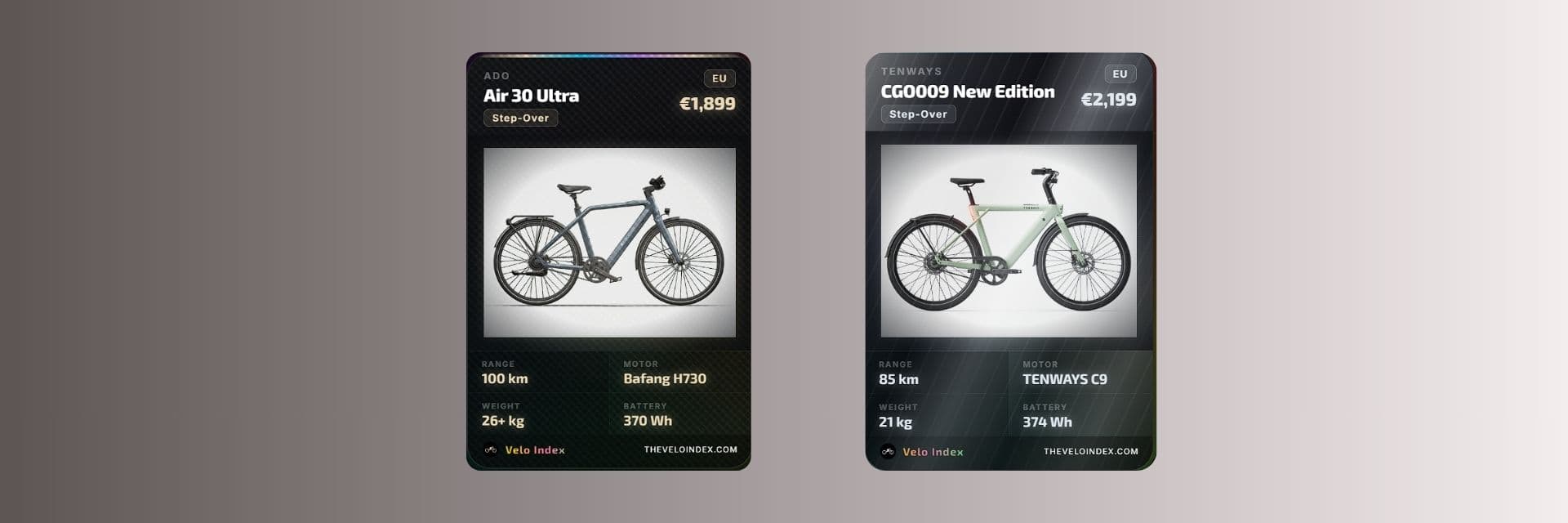
Smart-Connected Step-Over: ADO Air 30 Ultra vs Tenways CGO009 New Edition
The Air 30 Ultra (€1,999) and CGO009 New Edition (€2,199) are each brand's technology-led step-over commuter. The ADO pairs the Bafang H730 hub with automatic three-speed gear-shift, a 3.5-inch display, and built-in GPS anti-theft at 26+ kg. The Tenways pairs the single-speed TENWAYS C9 hub (45 Nm) with a Smart Connect module offering GPS tracking, motion detection, NFC contactless unlocking, and Apple Find My at 21 kg.
ADO Air 30 Ultra vs Tenways CGO009 New Edition
Smart-connected commuter spec comparison (EU)
| Spec | ADO Air 30 UltraAir 30 Ultra | Tenways CGO009 New EditionCGO009 |
|---|---|---|
| PricePrice | €1,999 | €2,199 |
| WeightWeight | 26+ kg | 21 kg |
| MotorMotor | Bafang H730 250W rear hub · 40 Nm | TENWAYS C9 250W rear hub · 45 Nm |
| BatteryBattery | 370 Wh · Removable | 374.4 Wh LG · Removable |
| Range1Range | 100 km (62 miles) | 85 km (53 miles) |
| Pedal sensorSensor | Torque sensor | Torque sensor |
| GearsGears | Automatic three-speed · carbon belt | Single-speed · Gates CDN belt, CDX crankset |
| SuspensionSusp. | Rigid | Rigid |
| BrakesBrakes | Hydraulic disc | Hydraulic disc |
| Form factorFrame | Step-over | Step-over |
| Smart featuresSmart | Built-in GPS anti-theft, 3.5" IPS display | GPS tracking, motion detection, NFC unlock, Apple Find My, colour display |
| ComplianceClass | EN15194 (250W, 25 km/h) | EN15194 (250W, 25 km/h) |
1 Manufacturer claimed. Real-world range varies by rider weight, terrain, and assist level.
The primary differences are the €200 price gap, the 5 kg weight gap and 45 Nm vs 40 Nm torque figure in the Tenways' favour, and the depth of the connectivity stack. Riders who want the fullest smart feature set (Find My, NFC unlock, motion detection) will note the CGO009's Smart Connect module; riders who want automatic three-speed gearing and the longer claimed range at the lower price will note the Air 30 Ultra. UK pricing is £1,499 for the Air 30 Ultra and £1,999 for the UK-market CGO009.
EU Belt-Drive E-Bikes Under €2,000
Belt drive options across EU brands, including ADO Air variants and Tenways CGO models
Drivetrain Architecture: Automatic Gear-Shift Hubs vs Mid-Drives
The clearest structural difference between the two ranges is how each brand handles gearing. ADO builds its entire EU and UK lineup on 250W hub motors, and differentiates upward through the Bafang automatic gear-shift system: Pro variants shift automatically between two internal speeds, while Ultra variants run two- or three-speed systems depending on generation, with the Air 30 Ultra on the three-speed H730 and the 2026 Air 20 Ultra on a second-generation dual-speed unit. The Air 30 Ultra was co-developed with Bafang as the first integrated Auto Triple-Speed e-bike. The rider never selects a gear; the motor responds to speed and load.
Tenways splits its range across two architectures instead. The CGO hub-motor commuters are predominantly single-speed belt drives (with 8-speed chain options on Plus variants), keeping the bikes simple and light. Above them sits the AGO mid-drive range, running Bafang M410/M420, TENWAYS proprietary, and Bosch Performance Line motors at 75 to 80 Nm, with manual derailleurs or Enviolo stepless hubs. ADO has no mid-drive equivalent, and Tenways has no automatic gear-shift hub equivalent.
Neither approach is inherently superior. Automatic hub gearing suits stop-start city riding with minimal rider input; mid-drives deliver higher torque through the bike's gearing and suit hillier terrain and touring loads. Riders should match the architecture to their route profile rather than to the brand.
Battery, Range and Weight
ADO standardises on compact batteries: 346Wh on the Air 20 and Air 28 series, 370Wh on the Air 30, Air Carbon, Air One, and 2026 Air 20 Ultra models, with claimed ranges of 100 km across the board and an optional second battery on the Air One cargo platform. This uniformity keeps weights between 14.5 kg (Air Carbon) and 31 kg (Air One cargo), with most models at 18 to 26 kg.
Tenways varies capacity by tier: 252Wh on the entry CGO 600, 360 to 374Wh on the CGO600 Pro and CGO009, 461 to 500Wh on the CGO800S and CGO Compact, and 504 to 562Wh on the AGO mid-drives. Claimed ranges run 70 to 100 km. Weights span 15 kg (CGO 600) to 30 kg (AGO T).
Within the compared pairs the pattern is mixed rather than one-sided: Tenways carried the larger battery in the compact pairing (500Wh vs 370Wh) and the step-through pairing (461Wh vs 346Wh), while capacity was near-identical in the smart-commuter pairing, where ADO claimed the longer range. On weight, ADO carried the lighter build in the compact pairing and Tenways in the other two. Both brands operate under the same EU 250W and 25 km/h ceiling, so battery capacity and weight, not motor power, are the practical differentiators.
Smart Features and Security
ADO integrates security hardware progressively up its range: battery locks on most models, built-in GPS anti-theft on the Air 30 series, Air Carbon, and Air Carbon Pro, and NFC unlock on the Air Carbon Pro. The ADO App connects on newer models, and the brand backs its hardware with an SGS-certified in-house testing laboratory.
Tenways concentrates its connectivity in the CGO009 and its cargo and premium models: the Smart Connect module provides GPS tracking, motion detection, theft detection, contactless NFC unlocking, and Apple Find My integration. Elsewhere in the CGO range, the smart layer is lighter, with StVZO-compliant lighting standard and app connectivity on selected models. Both brands treat GPS security as a mid-to-upper-tier feature rather than a range-wide standard, so riders comparing specific models should confirm it per model rather than per brand.
Pricing and Value Across the Range
ADO's EU range spans €1,199 (Air 20s) to €2,499 (Air Carbon Pro), with UK pricing from £999 to £1,799. Tenways' EU range spans €1,099 (CGO 600 Classic) to €4,999 (Cargo One), with UK pricing from £999 to £2,299; the upper band is occupied by mid-drive tourers and cargo models with no ADO equivalent, so the like-for-like commuter overlap sits between roughly €1,100 and €2,500.
Across the three compared pairings, ADO held the lower price in one (smart-connected), Tenways in one (step-through), and the compact pairing is level at €1,999, with gaps of up to €200. The pattern is not a consistent advantage: in the smart-connected pairing where ADO is cheaper, Tenways carries the fuller connectivity stack and lower weight, and in the step-through pairing where Tenways is cheaper, ADO carries automatic dual-speed gearing. In the level-priced compact pairing, ADO carries the lighter carbon frame and GPS security, and Tenways the larger battery. Value depends on which of those specs the rider weights.
Prices and specifications checked against the Velo Index dataset: September 2026.
Which Category Fits Your Ride?
Choosing between ADO and Tenways comes down to category priorities rather than an overall brand ranking. The two ranges overlap almost entirely in the urban commuter core, so the deciding factors are drivetrain preference, battery capacity, warranty weight, and whether the route needs a mid-drive at all.
ADO suits riders who want automatic gearing without a mid-drive price, GPS security integrated at mid-range price points, and a folding-heavy lineup with a carbon option under 15 kg. Its EU warranty policy runs 2 years on electrical components and 5 years on aluminium frames.
Tenways suits riders who want larger batteries on full-size commuters, four frame sizes on its core commuter, higher published hub torque, and a genuine mid-drive path (Bafang, proprietary, or Bosch) for hillier routes and touring, a category ADO does not enter.
The E-Bike Finder can narrow the comparison further by matching both brands' models to your specific commute distance, terrain, and budget across EU and UK markets.
FAQs
How do ADO and Tenways compare on price? The two ranges overlap almost completely in the EU commuter segment. ADO spans €1,199 to €2,499 (£999 to £1,799 in the UK) and Tenways spans €1,099 to €4,999 (£999 to £2,299), with Tenways' upper band covered by mid-drive tourers and cargo models that ADO does not offer. In the three directly compared pairings, ADO held the lower price in one, Tenways in one, and the compact pairing is level at €1,999, with gaps of up to €200.
Do ADO and Tenways both use torque sensors? Yes. Torque-sensing pedal assist is standard on every ADO and Tenways model sold in the EU and UK. Neither brand sells a cadence-only model in these markets.
What is the difference between ADO's automatic gears and Tenways' drivetrains? ADO's Pro and Ultra models use Bafang hub motors with built-in automatic gear-shift: dual-speed on Pro variants and dual- or three-speed on Ultra variants by generation (the Air 30 Ultra uses the three-speed unit), so the bike changes gear itself based on speed and load. Tenways uses single-speed belt drives on most CGO hub commuters, 8-speed chains on Plus variants, and manual or Enviolo stepless gearing on its mid-drive AGO range. ADO offers no mid-drive; Tenways offers no automatic gear-shift hub.
Where are ADO and Tenways e-bikes made? ADO e-bikes are designed and manufactured in China by Shenzhen Aodishi Technology at its Guangdong Huizhou Industrial Park. Tenways e-bikes are engineered in Amsterdam and manufactured in Guangdong (China), Manila (Philippines), and Ukmerge (Lithuania). The Lithuanian factory means part of the Tenways range involves EU-based assembly.
Do both brands use belt drives? ADO fits a carbon belt drive on every model in its EU and UK range. Tenways fits Gates carbon belts on most CGO models and on selected AGO models, with 8-speed chain drivetrains on Plus variants and the AGO X. Riders who want a chain option will only find one at Tenways; riders who want a belt on every model will find that only at ADO.
What warranty do ADO and Tenways offer? ADO's EU warranty policy provides 24 months on the motor, battery, controller, and display, 60 months on aluminium alloy frames (24 months on carbon fibre frames), and 12 months on GPS modules, with service centres in the UK, Germany, and Poland. Tenways provides a 2-year limited warranty on the motor and electrical components plus a 5-year frame warranty. Verify current regional terms on each brand's official warranty page before purchasing.
Compare Models on Velo Index
Both ADO and Tenways models appear across several EU and UK collections on Velo Index.
EU Lightweight Commuters Under 20kg
Weight-focused comparison including ADO folding models and Tenways CGO commuters
EU Belt-Drive E-Bikes Under €2,000
Low-maintenance belt drive options including multiple ADO Air and Tenways CGO variants
For removable-battery commuters, see EU Urban E-Bikes with Removable Batteries. For hill-capable routes where the Tenways mid-drives compete, see the EU Hilly Commute guide and EU Mid-Drive E-Bikes Under €2,500.
Not sure which model fits your route and budget? The E-Bike Finder matches e-bikes to your commute distance, terrain, and budget across EU, UK, and US markets.
Summary
ADO and Tenways are direct competitors across the EU and UK DTC commuter market. Both were founded in 2021, both sell torque-sensing, belt-driven, hydraulically braked commuters at overlapping prices, and both comply with the same EN15194 ceiling. The consistent structural difference across the matchups is the drivetrain: ADO differentiates through Bafang automatic gear-shift hubs and range-wide belt drives, while Tenways differentiates through battery capacity, frame sizing, a deeper smart-connectivity stack on its premium models, and a mid-drive range ADO does not match.
Neither brand holds a categorical advantage. Pricing split one each with one tie across the compared pairs, battery capacity favoured Tenways in two of the three, weight favoured Tenways in two pairs and ADO in the compact pairing, and warranty terms broadly align on 2-year electrical and 5-year frame cover. The choice comes down to whether a rider values automatic gearing, folding formats, and integrated GPS security, or larger batteries, sized frames, higher published hub torque, and a mid-drive upgrade path.
Velo Index readers can explore the ADO EU range at adoebike.com , and the UK range at adoebike.co.uk (affiliate links, see disclosure). The Tenways EU range is at tenways.com (affiliate link, see disclosure), with the UK range at tenways.co.uk.
Related reading: Brand Spotlight: ADO: full model guide covering the 14-variant ADO EU and UK range. Brand Spotlight: Tenways: full model guide covering the Tenways EU, UK, and US lineups.
Image Credit
Product imagery: ADO E-Bike / Tenways.
References
Every model from both brands
The full indexed range for each brand, with specifications sorted for side-by-side comparison.
All ADO models
Compare all 12 ADO e-bike models across EU, UK. Full specs for motor, battery, range, weight and price.
All Tenways models
Compare all 22 Tenways e-bike models across AU, EU, UK, USA. Full specs for motor, battery, range, weight and price.