Monarc vs Velotric: 2026 Model Comparisons, Specs and Prices
·
In this article
Monarc and Velotric are two direct-to-consumer e-bike brands competing in the US mid-range commuter and fat-tire market. Monarc launched in June 2026 with two platforms built around dual-batteries and a five-year warranty. Velotric fields a broad range of models across commuter, fat-tire, folding, cargo, lightweight, hybrid, and mid-drive categories. This article compares the two categories where both brands have a genuine entry, using specification data.
Monarc and Velotric are direct competitors in the US mid-range commuter and fat-tire e-bike market; their differences lie in batteries, warranty length, distribution, and connectivity rather than in overall price positioning.
At a Glance
Monarc launched in June 2026, founded by Julia Moran and Ryan Callahan, who both have industry experience and backed by Lectric eBikes. Velotric was founded in 2021 in California by Adam Zhang, hardware co-founder of Lime. Both brands sell online across the continental United States, and both carry UL 2271 and UL 2849 certification. Monarc ships every bike with two batteries as standard; Velotric ships single-battery bikes across a much wider model range.
Monarc vs Velotric brand overview
| Spec | Monarc | Velotric |
|---|---|---|
| FoundedEst. | 2026, Minneapolis, Minnesota | 2021, California |
| Business modelModel | DTC only, backed by Lectric eBikes | DTC + 1,200+ dealer partners |
| US price rangePrice | $1,899 to $1,999 | $1,099 to $2,399 |
| Motor typesMotor | Hub drive only (Bafang B750) | Hub drive, mid-drive (Discover M) |
| Sensor standardSensor | Torque + cadence | Torque + cadence (SensorSwap) on most models |
| Battery architectureBattery | Two 720Wh LG batteries included standard | Single battery, removable on most models |
| ConnectivitySmart | Touchscreen display, app, OTA, radar and TPMS options | NFC, Apple Find My, Android Find Hub, app |
| UL certificationUL | UL 2271, UL 2849 | UL 2271, UL 2849 |
| WarrantyWarr. | 5 years (1 year on battery) | 5 yr frame, 2 yr electrical, 1 yr other |
| RidersRiders | Not disclosed | 150,000+ (January 2026) |
Brand Origins and Distribution
Monarc launched in June 2026 from Minneapolis, Minnesota. It operates as an independent brand founded by Julia Moran and Ryan Callahan, and it is backed by Lectric eBikes, which supplies operational support, supply-chain leverage, and purchasing power. The brand's stated approach is to sell fewer, more fully equipped platforms: every Monarc bike ships with two 720Wh LG-cell batteries, a 5A fast charger, and a five-year warranty as standard. Monarc sells direct-to-consumer through monarcbikes.com with no dealer network, and support is handled remotely by its Minnesota-based team.
Velotric was founded in 2021 in California by Adam Zhang, who previously co-founded Lime as a hardware lead, with a broader team drawn from Giant, Specialized, and Decathlon. The brand launched direct-to-consumer and has since built a substantial retail presence: it passed 1,200 partner bike shops across 49 states in October 2025, alongside its own website and US-based warehouses. Velotric reported more than 150,000 riders across North America as of January 2026.
Both brands manufacture through international OEM partnerships and ship bikes to customers across the continental United States pre-assembled or requiring minimal assembly. The structural difference in distribution is notable: Monarc is currently online-only, while Velotric offers in-person test rides and service through its dealer network.
You can compare both brands' US models on Velo Index using the E-Bike Finder, which filters by commute distance, terrain, budget, and class.
Not sure which one fits your route?
Answer a few questions to match e-bikes to your commute distance, terrain and budget across the full index.
How the Lineups Compare: Category Overview
Monarc's range currently consists of two platforms, each sold in several frame styles and colourways: the Tracer, a city commuter, and the Marker, a fat-tire all-terrain model. Velotric's range spans a broad set of models across commuter, fat-tire, folding, cargo, lightweight, hybrid, and mid-drive categories.
This matters for buyers whose needs fall outside the two head-to-head categories, because Velotric currently fields several categories that Monarc does not offer at all. Velotric has a mid-drive commuter (the Discover M at $2,399), a dedicated cargo and utility model (the GoMad at $1,999), a folding range (from the Fold 1 Lite at $1,099 to the Fold 1 Plus at $1,449), lightweight city bikes (the T1 ST Plus at $1,299, the Tempo at $1,499, and the Breeze 1 at $1,699), and off-road trail models (the Summit 1 at $1,799 and the Summit 2 at $2,099). It also offers a dual-suspension fat-tire step-up, the Nomad 2X, at $2,299. Monarc, by contrast, concentrates on two fully equipped platforms. A rider who wants a mid-drive, a dedicated cargo hauler, a sub-20 kg folder, or rear suspension will currently find those only on the Velotric side of this comparison.
Conversely, both Monarc platforms land squarely in Velotric's two strongest categories, at nearly identical prices, which makes the head-to-head matchups unusually direct. The two sections below compare the categories where both brands have a genuine entry: the hub-drive commuter and the fat-tire all-terrain bike. Both matchups pair models within $250 of each other.
Commuter: Monarc Tracer vs Velotric Discover 3
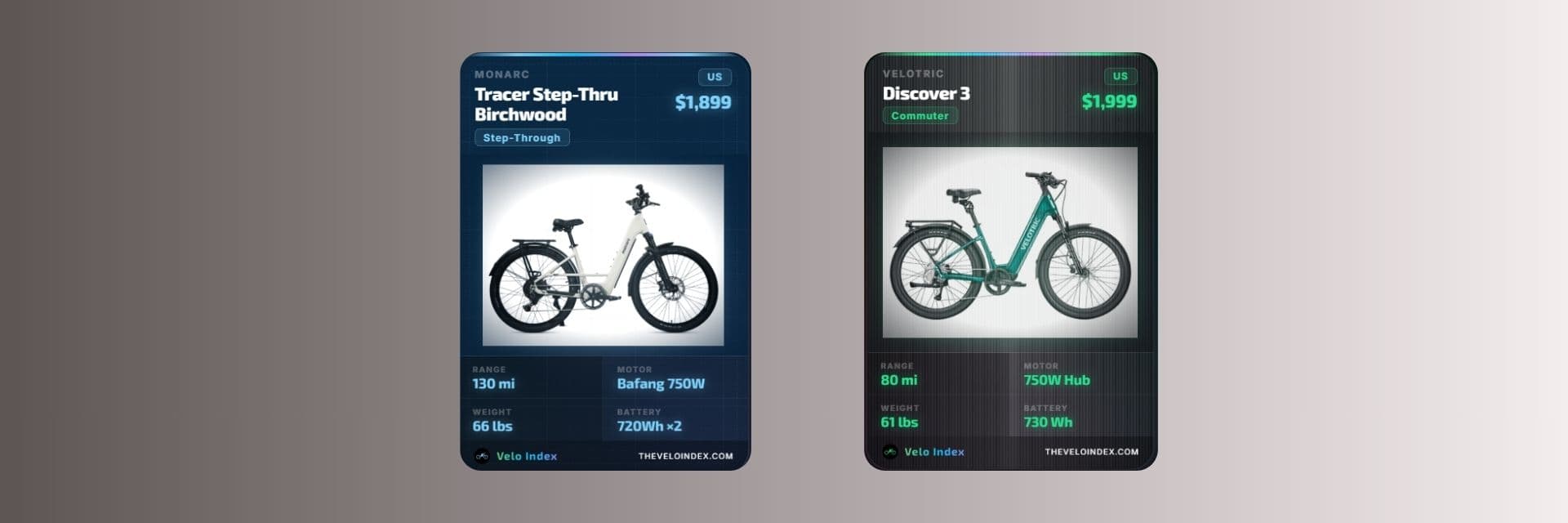
The Tracer and Discover 3 are each brand's primary step-through hub-drive commuter. The Tracer carries a Bafang B750 motor (1,638W peak, 85 Nm) and two 720Wh LG batteries for a 130-mile claimed range at $1,899. The Discover 3 carries a single 730Wh battery, a 750W motor (1,100W peak, 75 Nm), and an 80-mile claimed range at $1,999, but is 2.3 kg lighter and adds NFC unlock, Apple Find My, and Android Find Hub. Both use combined torque and cadence sensing, hydraulic disc brakes, an 80mm suspension fork, integrated lights with turn signals, and a throttle.
Monarc Tracer vs Velotric Discover 3
Commuter hub-drive spec comparison (US)
| Spec | Monarc TracerTracer | Velotric Discover 3Discover 3 |
|---|---|---|
| PricePrice | $1,899 | $1,999 |
| WeightWeight | 29.9 kg | 27.7 kg |
| MotorMotor | Bafang B750 750W rear hub / 1,638W peak · 85 Nm | 750W rear hub / 1,100W peak · 75 Nm |
| BatteryBattery | 1,440 Wh total (2 x 720 Wh LG) · Removable | 730 Wh Samsung/LG 21700 · Removable |
| Range1Range | 130 miles2 | 80 miles |
| Pedal sensorSensor | Torque + cadence | Torque + cadence (SensorSwap, switchable) |
| GearsGears | 9-speed Shimano CUES | 8-speed Shimano |
| SuspensionSusp. | Gneiss reverse-arch fork 80mm with lockout | 80mm air fork with lockout + suspension seatpost |
| BrakesBrakes | Star Union Talon P4 4-piston hydraulic · 203mm front / 180mm rear | Tektro hydraulic · 180mm front/rear |
| Form factorFrame | Step-through or step-over | Step-through only |
| Smart featuresSmart | 3.5 inch touchscreen, app, OTA, smart helmet and radar connectivity | NFC unlock, Apple Find My, Android Find Hub, app |
| ThrottleThrottle | Thumb throttle | Yes (removable) |
| E-bike classClass | Class 1 / 2 / 3 | Class 1 / 2 / 3 |
| WarrantyWarr. | 5 years (1 year on battery) | 5 yr frame / 2 yr electrical / 1 yr other |
1 Manufacturer claimed. Real-world range varies by rider weight, terrain, and assist level.
2 Monarc's range figure reflects both included 720Wh batteries; a single battery is claimed at up to 65 miles.
Prices checked September 2026 and are subject to change.
The primary differences are battery architecture, weight, and connectivity approach. The Tracer's two included batteries produce a 130-mile combined claimed range and a $1,899 price, alongside 4-piston brakes and a five-year warranty; the Discover 3 is 2.3 kg lighter, adds NFC keyless unlock and both major phone-tracking ecosystems, and can be tested and serviced through Velotric's dealer network. Riders whose commute involves long distances or infrequent charging gain most from the Tracer's second battery; riders who carry the bike up stairs or prioritise theft tracking will notice the Discover 3's weight and connectivity daily. The Tracer is also available in a step-over frame, which the Discover 3 does not offer.
US E-Bikes with 80+ Miles of Claimed Range
Range-focused comparison covering long-range commuters, including the Tracer and the Discover 3
Fat Tire All-Terrain: Monarc Marker vs Velotric Nomad 2
The Marker and Nomad 2 are directly matched fat-tire platforms: both use a 750W rear hub motor, a front suspension fork with lockout, 26x4.0 Kenda tyres, combined torque and cadence sensing, and a throttle, and both are sold in step-through and step-over frames. The Marker carries two 720Wh batteries for a 120-mile claimed range at $1,999; the Nomad 2 carries a single 706Wh battery for a 65-mile claimed range at $1,749 and is 5.5 kg lighter. Velotric's dual-suspension Nomad 2X ($2,299, 105 Nm, 802Wh) sits one step above this matchup and is discussed in the synthesis below.
Monarc Marker vs Velotric Nomad 2
Fat-tire all-terrain spec comparison (US)
| Spec | Monarc MarkerMarker | Velotric Nomad 2Nomad 2 |
|---|---|---|
| PricePrice | $1,999 | $1,749 |
| WeightWeight | 39.5 kg | 34.0 kg |
| MotorMotor | Bafang B750 750W rear hub / 1,638W peak · 85 Nm | 750W rear hub · 90 Nm |
| BatteryBattery | 1,440 Wh total (2 x 720 Wh LG) · Removable | 706 Wh Samsung/LG 21700 · Removable |
| Range1Range | 120 miles2 | 65 miles |
| Pedal sensorSensor | Torque + cadence | Torque + cadence (SensorSwap, switchable) |
| GearsGears | 9-speed Shimano CUES | 8-speed Shimano |
| SuspensionSusp. | Gneiss reverse-arch fork 80mm with lockout (front only) | RST fork 100mm with lockout + suspension seatpost (front only) |
| BrakesBrakes | Star Union Talon P4 4-piston hydraulic · 203mm front / 180mm rear | Tektro hydraulic · 203mm front / 180mm rear |
| TyresTyres | Kenda 26x4.0 all-terrain | Kenda 26x4.0 puncture-resistant |
| Form factorFrame | Step-through or step-over | Step-through or step-over |
| Smart featuresSmart | Touchscreen, MOLLE panel, MIK rack (30 kg), radar and TPMS options | Apple Find My, turn signals, light-sensing LED headlight |
| ThrottleThrottle | Thumb throttle | Yes |
| E-bike classClass | Class 1 / 2 / 3 | Class 1 / 2 / 3 |
| WarrantyWarr. | 5 years (1 year on battery) | 5 yr frame / 2 yr electrical / 1 yr other |
1 Manufacturer claimed. Real-world range varies by rider weight, terrain, and assist level.
2 Monarc's range figure reflects both included 720Wh batteries; a single battery is claimed at up to 60 miles.
Prices checked September 2026 and are subject to change.
The primary differences are total battery capacity, weight, and warranty. The Marker's second battery doubles claimed range to 120 miles and its MOLLE panel and 30 kg MIK rack lean toward utility use, at a cost of 5.5 kg of extra weight. The Nomad 2 delivers slightly higher torque (90 Nm vs 85 Nm), a longer-travel fork, a suspension seatpost, and Apple Find My at a $250 lower price ($1,749). Riders wanting rear suspension in this category should note that neither model offers it; Velotric's Nomad 2X at $2,299 adds a 120mm air fork, a DNM rear air shock, and 105 Nm of torque with a single 802Wh battery, and is the closest dual-suspension alternative to this pairing.
US Torque Sensor E-Bikes Under $2,000
Torque-sensing models in the price bracket this matchup occupies, sorted by price
Dual-Battery Architecture and Range
The defining structural difference between these two brands is how they package battery capacity. Monarc includes two 720Wh LG-cell batteries with every bike, for 1,440Wh of total capacity, plus a 48V 5A fast charger with a smart charge limiter. The headline range figures (120 miles for the Marker, 130 for the Tracer) assume both batteries are used; per battery, the claimed figures are roughly 60 to 65 miles, which is in line with single-battery competitors carrying 700Wh-class packs.
Velotric ships single batteries in the 706Wh to 802Wh band across its mid-range models, with claimed ranges of 65 to 95 miles depending on the model. On paper this gives Monarc roughly double the included capacity at similar prices; in daily use, the difference matters most to riders covering long distances between charges, running errands on throttle, or riding through winters that reduce battery performance. Riders with short commutes and easy charging access may find a single 730Wh pack covers their week, at a meaningful weight saving. As with all range figures on Velo Index, both brands' numbers are manufacturer-claimed and real-world results will be lower.
Connectivity and Smart Features
The two brands take different approaches to on-bike technology. Monarc builds around its 3.5 inch colour touchscreen with Bluetooth, USB charging, and over-the-air updates, paired with the Monarc App for ride tuning and navigation. It also offers accessory-level safety technology uncommon at this price: an optional Rear-Vehicle Alert radar system ($89), an optional tyre pressure monitoring sensor ($89), and smart helmet connectivity.
Velotric focuses on access and theft deterrence: NFC card unlock, Apple Find My, and Android Find Hub are integrated on the Discover 3, alongside app-based over-the-air updates and turn-signal lighting. The Nomad 2 carries Apple Find My and light-sensing LED control. Neither approach is inherently superior; riders who park on the street will weigh Velotric's native phone-ecosystem tracking, while riders who ride in traffic may weigh Monarc's radar option. Both brands fit integrated lights with brake-light and turn-signal functions as standard on the compared models.
Warranty and After-Sales Support
Both brands lead with a headline warranty figure, and both terms are tiered by component rather than flat. Monarc's five-year warranty covers the frame and most parts, including the motor, controller, display, and wiring, but the batteries originally supplied with the bike are covered for one year. Velotric's warranty is tiered differently: five years on the frame, two years on the core electrical parts (motor, controller, wiring, lights, sensor, and charger), and one year on suspension forks, brakes, drivetrain components, and accessories. Its battery is warranted to roughly 300 charge cycles, over which Velotric states the cell is designed to retain up to 75 percent of its capacity. Monarc therefore carries the longer term on most non-battery components, while both brands cover the battery itself for a shorter window than the five-year and two-year headlines suggest.
Coverage geography and service structure also differ. Monarc's warranty extends across the 48 contiguous US states plus Washington DC and into Canada, and because Monarc is online-only, all claims are handled remotely by its Minnesota-based team. Velotric's warranty applies to bikes bought through velotricbike.com in the lower 48 states and excludes Alaska, Hawaii, and US territories, but its network of more than 1,200 dealer partner shops means many riders can access in-person diagnosis and service locally. Velotric's coverage is also tied to the first owner and is not transferable, though later owners can still contact its support team. Which structure serves a rider better depends on how they weigh a longer term on most parts against local physical access, and both buyers should check the battery and wear-part terms against their own mileage.
Pricing and Value Across the Range
Monarc's range occupies a narrow $1,899 to $1,999 band. Velotric spans $1,099 (Fold 1 Lite) to $2,399 (Discover M), with its directly competing models at $1,749 (Nomad 2) and $1,999 (Discover 3).
Across the two matchups, the Tracer undercuts the Discover 3 by $100 in the commuter category, while the Nomad 2 undercuts the Marker by $250 in the fat-tire category. Each brand therefore holds the lower price in one matchup. The value question turns instead on what each dollar buys: Monarc bundles a second battery, 4-piston brakes, and a five-year warranty; Velotric delivers lower weight, switchable sensing, phone-ecosystem tracking, dealer access, and a wider range of alternatives above and below this price band.
Prices and specifications checked against the Velo Index dataset: September 2026.
Which Category Fits Your Ride?
Choosing between Monarc and Velotric comes down to riding pattern and support preference rather than an overall brand ranking.
Riders covering long daily distances, riding in cold climates, or wanting maximum time between charges are the audience Monarc's dual-battery architecture is built for, and the five-year warranty extends that long-haul positioning. Riders who prioritise a lighter bike, switchable torque and cadence feel, NFC and Find My tracking, or the option to test ride and service the bike at a local shop will find Velotric's Discover 3 and Nomad 2 address those requirements at comparable prices ($1,999 and $1,749).
Riders whose needs fall outside these two categories (folding, cargo, lightweight sub-20 kg, or mid-drive) will currently only find options on the Velotric side of this comparison, as Monarc fields two platforms.
The E-Bike Finder can narrow the comparison further by matching both brands' models to your specific commute distance, terrain, and budget.
FAQs
How do Monarc and Velotric compare on price? Monarc's two current platforms sit at $1,899 (Tracer) and $1,999 (Marker), in several frame styles and colourways at the same price. Velotric spans $1,099 (Fold 1 Lite) to $2,399 (Discover M). In the commuter matchup the Tracer is $100 below the Discover 3, and in the fat-tire matchup the Nomad 2 is $250 below the Marker.
Who makes Monarc e-bikes? Monarc is an independent brand founded by Julia Moran and Ryan Callahan and launched in June 2026 from Minneapolis, Minnesota. It is backed by Lectric eBikes, which provides operational, supply-chain, and purchasing support. Monarc sells direct-to-consumer through its own website.
Why does Monarc claim 120 to 130 miles of range? Every Monarc bike ships with two 720Wh LG-cell batteries as standard, for 1,440Wh of total capacity. The headline range figures assume both batteries; a single battery is claimed at roughly 60 to 65 miles, comparable to single-battery competitors with 700Wh-class packs. All figures are manufacturer-claimed.
Which brand offers a longer warranty? Monarc's five-year warranty covers the frame and most components, but the originally supplied battery is covered for one year. Velotric's warranty is tiered: five years on the frame, two years on the core electrical parts, and one year on suspension forks, brakes, drivetrain parts, and accessories, with the battery warranted to roughly 300 charge cycles. Monarc holds the longer term on most non-battery parts; Velotric handles many claims in person through its dealer partner network, while Monarc support is remote.
Can I test ride either brand before buying? Velotric models are available for test rides through more than 1,200 dealer partner bike shops across 49 US states. Monarc currently sells online only, with no dealer network, so test rides are not generally available before purchase.
Do both brands offer step-through frames? Yes. Both the Monarc Tracer and Marker are sold in step-through and step-over frames at the same price. Velotric's Discover 3 is step-through only, while the Nomad 2 offers both frame styles.
Do both brands use torque sensors? Yes. Monarc's Tracer and Marker use combined torque and cadence sensing. Most current Velotric models use SensorSwap, which additionally lets the rider switch between torque-sensing and cadence-sensing modes. Check individual Velotric model specifications, as a few models use cadence sensing only.
Are Monarc and Velotric bikes UL certified? Yes. The compared models from both brands carry UL 2849 certification for the electrical system and UL 2271 certification for the battery, alongside ISO 4210 and IPX-rated water resistance.
Compare Models on Velo Index
Models from both brands appear in US collections on Velo Index.
US E-Bikes with 80+ Miles of Claimed Range
Long-range models sorted by claimed range, including dual-battery options
US Torque Sensor E-Bikes Under $2,000
Torque-sensing models under $2,000, the bracket where both brands compete
For Velotric's wider range beyond this comparison, see US Mid-Drive E-Bikes Under $2,500, US Folding E-Bikes Under $1,500, and US Lightweight E-Bikes Under 50 lbs. To match models to your own route and budget, use the E-Bike Finder.
Summary
Monarc and Velotric are direct competitors in the US mid-range commuter and fat-tire market, with both matchups in this comparison priced within $250 of each other. The consistent structural difference is architecture and support: Monarc bundles two 720Wh batteries, 4-piston brakes, and a five-year warranty into two focused platforms sold online only, while Velotric offers lower weight, switchable SensorSwap sensing, NFC and phone-ecosystem tracking, a two-year warranty, and access through 1,200+ dealer shops across a broader model range.
Neither brand holds an across-the-board advantage; the compared dimensions divide between them. Price favoured Monarc in the commuter pairing and was level in the fat-tire pairing; range and warranty favoured Monarc throughout; weight, connectivity breadth, and dealer access favoured Velotric throughout. The choice comes down to whether a rider values included capacity and warranty length or lower weight, dealer access, and range breadth.
Monarc's range is available at monarcbikes.com. Velo Index readers can explore the Velotric range at velotricbike.com and use code REF603163 for $60 off any order (affiliate link, see disclosure).
Related reading: Brand Spotlight: Velotric: full model guide covering the Velotric US lineup including 2026 additions. Velotric vs Lectric: 2026 Model Comparisons: how Velotric compares with Lectric, the brand backing Monarc.
Image Credit
Product imagery: Monarc / Velotric.
References
Every model from both brands
The full indexed range for each brand, with specifications sorted for side-by-side comparison.
All Monarc models
Compare all 7 Monarc e-bike models across USA. Full specs for motor, battery, range, weight and price.
All Velotric models
Compare all 20 Velotric e-bike models across CA, USA. Full specs for motor, battery, range, weight and price.