ADO vs ENGWE: 2026 Model Comparisons, Specs and Prices
In this article
Excerpt: ADO and ENGWE are two Guangdong-based direct-to-consumer brands. ADO has built its whole range around a carbon belt and automatic shifting. ENGWE covers more variety on chains, derailleurs and fat-tyre offerings, from €599 folders to carbon city bikes and mid-drives.
ADO and ENGWE compete on price in the same EU and UK commuter bracket; ADO is built around belt drive, automatic shifting and a five-year frame warranty, ENGWE around wider gearing, larger batteries, carbon city frames and a much broader range of formats.
The Short Answer
ADO's folders are lighter than ENGWE's, but ENGWE's carbon-framed N1 city bikes are lighter than ADO's aluminium ones.
The decision mostly comes down to drivetrain. Every ADO runs a carbon belt, and the Pro and Ultra models change gear on their own, so there is nothing to oil. Almost every ENGWE runs a chain and a 7 or 8-speed derailleur, which gives more help on hills and needs more upkeep.
One number to treat with care: both brands claim 100 km from batteries of 346 Wh to 370 Wh. Expect nearer 42 to 45 km on mixed terrain, and less at higher assist levels. That applies to both brands equally, so it should not decide between them, but it should decide how often you plan to charge.
Jump to a matchup:
- ADO Air 20S vs ENGWE P20: lightweight folders
- ADO Air 28 vs ENGWE N1 Air (ST): step-through city bikes
- ADO Air 30 Pro vs ENGWE N1 Pro: step-over city bikes
- ADO Air 20 Ultra vs ENGWE L20 3.0 Pro: premium folders
The four matchups at a glance
EU / UK prices as listed in the Velo Index dataset, checked 1 October 2026
| Category | ADO | ENGWE | The real choice |
|---|---|---|---|
| Lightweight folding | Air 20S · €1,199 / £1,299 · 18 kg | P20 · €999 / £799 · 18.5 kg | Near-identical spec; ADO adds anti-theft |
| Step-through city | Air 28 · €1,299 / £999 · 20+ kg | N1 Air (ST) · €1,249 / £1,199 · 16.4 kg | Belt and hydraulic brakes vs carbon frame and gears |
| Step-over city | Air 30 Pro · €1,699 / £1,399 · 26+ kg | N1 Pro · €1,599 / £1,599 · 19 kg | Automatic belt hub vs carbon mid-drive |
| Premium folding | Air 20 Ultra · €1,899 / £1,799 · 22 kg | L20 3.0 Pro · €1,699 / £1,399 · 32.8 kg | Carryable vs double the battery |
Velo Index reader discount codes
Codes as listed by each brand for Velo Index readers. Codes can change, so confirm the discount at checkout.
| Brand | Code | Discount | Where it works |
|---|---|---|---|
| ADO | EDM50 | €50 off orders over €999 | EU store (adoebike.com); no UK code listed |
| ENGWE | VELOINDEX | 10% off | EU and UK stores |
How we compared: every figure comes from the Velo Index dataset, built from the brands' own published specifications and checked against their EU and UK storefronts. Velo Index has not ridden these bikes. Claimed ranges are manufacturer statements; planning ranges are our own estimates, and the formula is shown under each table. Full details are on the methodology page.
Not sure which one fits your route?
Answer a few questions to match e-bikes to your commute distance, terrain and budget across the full index.
ADO Air 20S vs ENGWE P20: Lightweight Folding Commuters
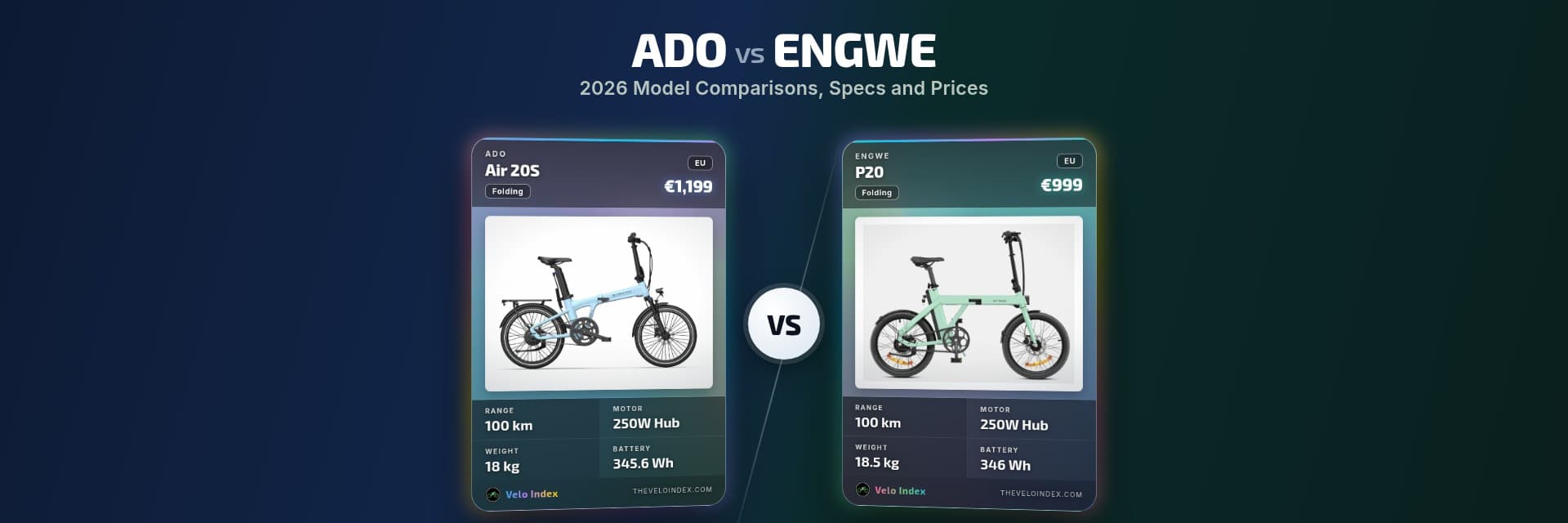
On paper these are as close as two bikes from different brands get. Both are 20-inch folders on a carbon belt with a torque sensor and 42 Nm, their batteries differ by less than half a watt-hour, and both carry a 120 kg rider limit. The P20 is €200 cheaper; the Air 20S is half a kilo lighter and adds ADO's AQS 2.0 anti-theft system. At 18 kg and 18.5 kg, both sit in the lighter third of the 40 EU folding e-bikes under €2,000 in the Velo Index dataset, where the median is about 22 kg.
ADO Air 20S (2026) vs ENGWE P20
Lightweight folding commuter spec comparison (EU). Both 250W, 25 km/h.
| Spec | ADO Air 20S (2026)Air 20S | ENGWE P20P20 |
|---|---|---|
| Price (EU)Price | €1,199 | €999 |
| WeightWeight | 18 kg | 18.5 kg |
| MotorMotor | Vinka 250W rear hub | 250W rear hub |
| TorqueTorque | 42 Nm | 42 Nm |
| BatteryBattery | 345.6 Wh 36V · Removable | 346 Wh Samsung 36V · Removable |
| Claimed range1Claimed | 100 km | 100 km |
| Planning range2Planning | 42 km mixed / 32 km hilly | 42 km mixed / 32 km hilly |
| Charge timeCharge | 4 to 6 hours | 5 hours |
| Pedal sensorSensor | Torque sensor | Torque sensor |
| DrivetrainDrive | Single-speed belt | Carbon belt3 |
| BrakesBrakes | Hydraulic disc | Hydraulic disc |
| SecuritySmart | AQS 2.0 anti-theft, ADO Smart App | - |
| Rider weight limitLimit | 120 kg | 120 kg |
1 Manufacturer claimed. 2 Velo Index planning range: battery capacity divided by 7.5 Wh/km (mixed terrain) or 9.75 Wh/km (hilly), with a 10% reserve, the same formula used in Velo Index finder guides. It ignores bike and rider weight, so heavier bikes will fall short of it. A planning estimate, not a tested range. 3 ENGWE lists a carbon belt but no gear count for the P20. * No anti-theft or tracking feature is listed for the P20; shown as -.
What the numbers don't tell you. For a folder, the figure that matters most on a train or in a lift is folded size. Half a kilo will not be noticed; a fold that is 10 cm wider than the luggage rack will be.
Pick the Air 20S if you leave the bike locked outside, want app-linked anti-theft, or want the frame and hinge covered for five years. Pick the P20 if price matters most: in the EU it costs €200 less, and in the UK the gap is £500 (£799 against £1,299) for nearly the same specification.
Before you buy, check: folded dimensions against your train's or office's storage rules, and whether either bike can be wheeled while folded.
- ADO's lightest option: the Air Carbon at €1,999 EU / £1,799 UK, listed from 14.5 kg on a 370 Wh battery, is the lightest model either brand publishes
- ENGWE with gears: the Zip at €1,099 EU / £999 UK adds 7-speed gearing and a suspension seatpost on 16-inch wheels at 19.4 kg
Current EU prices: ADO Air 20S at adoebike.com · ENGWE P20 at engwe-bikes-eu.com (affiliate links, see disclosure).
EU Lightweight Commuters Under 20 kg
Sub-20 kg commuters across EU brands, including the ADO Air 20S and the ENGWE P20
ADO Air 28 vs ENGWE N1 Air (ST): Step-Through City Bikes
Two step-through city bikes €50 apart that are built on opposite ideas. The Air 28 (€1,299, 20 kg plus) is an aluminium bike with a carbon belt, hydraulic brakes and a suspension fork. The N1 Air (ST) (€1,249, 16.4 kg) has a carbon frame, a Shimano 7-speed chain, mechanical brakes and GPS tracking with geo-fencing.
ADO Air 28 vs ENGWE N1 Air (ST)
Step-through city bike spec comparison (EU). Both 250W, 25 km/h.
| Spec | ADO Air 28Air 28 | ENGWE N1 Air (ST)N1 Air ST |
|---|---|---|
| Price (EU)Price | €1,299 | €1,249 |
| WeightWeight | 20+ kg3 | 16.4 kg |
| MotorMotor | 250W rear hub | Mivice M070 250W rear hub |
| TorqueTorque | - | - |
| BatteryBattery | 346 Wh 36V · Removable | 360 Wh Samsung 36V · Removable |
| Claimed range1Claimed | 100 km | 100 km |
| Planning range2Planning | 42 km mixed / 32 km hilly | 44 km mixed / 34 km hilly |
| Charge timeCharge | 4 to 6 hours | 5 to 8 hours |
| Pedal sensorSensor | Torque sensor | Torque sensor |
| DrivetrainDrive | Single-speed carbon belt | Shimano 7-speed chain |
| BrakesBrakes | Hydraulic disc | Mechanical disc · 160mm |
| SuspensionSusp. | Front suspension fork | Rigid |
| FrameFrame | Step-through, 28-inch wheels | Step-through, carbon, 700x38C tyres |
| SecuritySmart | Battery lock | GPS tracking, geo-fencing, motion detection |
1 Manufacturer claimed. 2 Velo Index planning range: battery capacity divided by 7.5 Wh/km (mixed terrain) or 9.75 Wh/km (hilly), with a 10% reserve, the same formula used in Velo Index finder guides. It ignores bike and rider weight, so heavier bikes will fall short of it. A planning estimate, not a tested range. 3 ADO lists the Air 28 as 20+ kg; Velo Index records the figure as published. * Neither brand lists a torque figure for these two models; shown as -.
What the numbers don't tell you. The N1 Air's weight comes from its carbon frame, which is light but less tolerant of a hard knock than aluminium, and on this bike it carries a 12-month warranty against five years on the Air 28's frame. A carbon frame that falls over in a bike shed should be inspected; an aluminium one usually just gets a scratch. The brakes also differ in kind: hydraulic discs self-adjust as the pads wear and need less hand force, while mechanical discs need periodic cable adjustment. On a heavier rider or a wet descent, that is a difference you feel at the lever.
Pick the Air 28 if your route has rough surfaces or steep descents, or you want the belt's no-oil upkeep and the five-year frame cover (confirm current terms when purchasing, as they can change). Pick the N1 Air (ST) if you carry the bike up steps, want gears for hills, or want GPS tracking built in. In the UK the price order reverses: the Air 28 is £999 and the N1 Air (ST) £1,199.
Before you buy, check: whether ENGWE's GPS tracking needs a data subscription after any included period.
- ENGWE's cheaper step-through: the P275 SE at €999 EU / £849 UK carries a 468 Wh battery, hydraulic discs and a suspension fork at 24 kg
- ADO's upgrade path: the Air 28 Pro at €1,899 EU / £1,599 UK, which ADO describes as automatic gear shifting with a Bafang motor
Current EU prices: ADO Air 28 at adoebike.com · ENGWE N1 Air (ST) at engwe.com (affiliate links, see disclosure).
EU Step-Through E-Bikes Under €1,500
Step-through frames under €1,500 across EU brands, including the ADO Air 28 and the ENGWE N1 Air (ST)
ADO Air 30 Pro vs ENGWE N1 Pro: Step-Over City Bikes
The clearest hub-against-mid-drive contrast between the two brands. The Air 30 Pro (€1,699, 26 kg plus) uses a Bafang H700 rear hub with an automatic two-speed carbon belt. The N1 Pro (€1,599, 19 kg) uses an Ananda mid-drive rated at 80 Nm through a Shimano 7-speed chain on a carbon frame, and recharges in two hours against four to six.
ADO Air 30 Pro vs ENGWE N1 Pro
Step-over city bike spec comparison (EU). Both 250W, 25 km/h.
| Spec | ADO Air 30 ProAir 30 Pro | ENGWE N1 ProN1 Pro |
|---|---|---|
| Price (EU)Price | €1,699 | €1,599 |
| WeightWeight | 26+ kg3 | 19 kg |
| MotorMotor | Bafang H700 250W rear hub | Ananda 250W mid-drive |
| Torque4Torque | - | 80 Nm at the crank |
| BatteryBattery | 370 Wh 37V · Removable | 360 Wh 36V · Removable |
| Claimed range1Claimed | 100 km | 100 km |
| Planning range2Planning | 45 km mixed / 34 km hilly | 44 km mixed / 34 km hilly |
| Charge timeCharge | 4 to 6 hours | 2 hours |
| Pedal sensorSensor | Torque sensor | Torque sensor |
| DrivetrainDrive | Automatic two-speed, carbon belt | Shimano 7-speed chain |
| BrakesBrakes | Hydraulic disc | Hydraulic disc |
| FrameFrame | Step-over | Step-over, carbon, rigid fork, 700x42C tyres |
| SecuritySmart | GPS anti-theft | Anti-theft, smart lock, smart lighting |
1 Manufacturer claimed. 2 Velo Index planning range: battery capacity divided by 7.5 Wh/km (mixed terrain) or 9.75 Wh/km (hilly), with a 10% reserve, the same formula used in Velo Index finder guides. It ignores bike and rider weight, so heavier bikes will fall short of it. A planning estimate, not a tested range. 3 ADO lists the Air 30 Pro as 26+ kg; Velo Index records the figure as published. 4 Mid-drive torque is measured at the crank and multiplied through the gears; hub-motor torque acts at the wheel. The two figures are not directly comparable. * ADO does not list a torque figure for the Air 30 Pro; shown as -.
What the numbers don't tell you. A mid-drive and a hub motor deliver help differently. The N1 Pro's motor turns the cranks, so on a climb you shift down and the motor's effort is multiplied by the gearing, the same way your legs are. The Air 30 Pro's hub pushes the rear wheel directly and relies on its two automatic ratios. That is why the torque figures in the table cannot be set side by side, and why a mid-drive with seven gears is the layout most often specified for sustained climbs. The trade is upkeep: a mid-drive puts its force through the chain and cassette, which wear faster under that load than a belt does.
Pick the Air 30 Pro if your routes are flat or rolling and you want a drivetrain that needs no oil and no gear changes, plus GPS anti-theft and five years on the frame. Pick the N1 Pro if you climb regularly, lift the bike, or charge at work, where a two-hour charge fits inside a shift. In the UK the order flips: the Air 30 Pro is £1,399 and the N1 Pro £1,599.
Before you buy, check: whether the Air 30 Pro has a suspension fork, which its listing does not state, and how ENGWE supplies parts for the Ananda mid-drive once the 12-month warranty ends.
- ADO's upgrade path: the Air 30 Ultra at €1,999 EU / £1,499 UK moves to a Bafang H730 with automatic three-speed shifting
- ENGWE's lighter hub option: the step-over N1 Air at €1,249 EU / £1,199 UK is 15.6 kg on a Mivice M070 rear hub with 7 speeds
Current EU prices: ADO Air 30 Pro at adoebike.com · ENGWE N1 Pro at engwe-bikes-eu.com (affiliate links, see disclosure).
EU Belt-Drive E-Bikes Under €2,000
Low-maintenance belt-drive options under €2,000 across EU brands, including the ADO Air 30 Pro and the ENGWE P20
ADO Air 20 Ultra vs ENGWE L20 3.0 Pro: Premium Folders
Each brand's most expensive 20-inch folder, built for different riders. The Air 20 Ultra (€1,899, 22 kg) is a carryable folder with an automatic two-speed belt and a lockout fork. The L20 3.0 Pro (€1,699, 32.8 kg) is closer to a compact all-rounder that happens to fold: a Mivice mid-drive, a 720 Wh battery, 3-inch tyres, rear suspension, GPS tracking and a 150 kg rider limit.
ADO Air 20 Ultra (2026) vs ENGWE L20 3.0 Pro
Premium folding spec comparison (EU). Both 250W, 25 km/h.
| Spec | ADO Air 20 Ultra (2026)Air 20 Ultra | ENGWE L20 3.0 ProL20 3.0 Pro |
|---|---|---|
| Price (EU)Price | €1,899 | €1,699 |
| WeightWeight | 22 kg | 32.8 kg |
| MotorMotor | Bafang H730 250W rear hub | Mivice X700 250W mid-drive, 48V |
| Torque3Torque | 50 Nm at the wheel | 100 Nm at the crank |
| BatteryBattery | 370 Wh 37V · Removable | 720 Wh Samsung 21700 48V · Removable |
| Claimed range1Claimed | 100 km | 135 km |
| Planning range2Planning | 45 km mixed / 34 km hilly | 87 km mixed / 67 km hilly |
| Charge timeCharge | 4 to 6 hours | 2 hours |
| DrivetrainDrive | Automatic two-speed belt | Shimano Tourney 7-speed chain |
| SuspensionSusp. | Front: aluminium lockout fork | Front: hydraulic lockout fork; rear: 30mm |
| TyresTyres | 20 x 2.0 inch | 20 x 3.0 inch, anti-puncture layer |
| SecuritySmart | AQS 2.0 anti-theft, NFC power control | GPS and 4G module, smart anti-theft |
| Rider weight limitLimit | 120 kg | 150 kg |
1 Manufacturer claimed. 2 Velo Index planning range: battery capacity divided by 7.5 Wh/km (mixed terrain) or 9.75 Wh/km (hilly), with a 10% reserve, the same formula used in Velo Index finder guides. It ignores bike and rider weight, so heavier bikes will fall short of it. A planning estimate, not a tested range. 3 Mid-drive torque is measured at the crank and multiplied through the gears; hub-motor torque acts at the wheel. The two figures are not directly comparable.
What the numbers don't tell you. These are both called folders, but they fold for different reasons. At 22 kg, the Air 20 Ultra sits on the dataset median for EU folders under €2,000 and can be lifted onto a train by one person. At 32.8 kg, the L20 3.0 Pro is among the heaviest in that group; it folds to fit a car boot, and most riders will wheel it rather than carry it. Its planning range of about 87 km on mixed terrain is roughly double the Air 20 Ultra's, but the formula ignores weight, and moving an extra 10.8 kg costs energy, so the real gap will be somewhat narrower.
Pick the Air 20 Ultra if the bike has to be carried: onto a train, up stairs, into an office. Pick the L20 3.0 Pro if it only folds for storage and you want range, comfort on rough roads, a higher rider limit or GPS tracking. In the UK the gap widens to £400, at £1,799 against £1,399.
Before you buy, check: the folded size and folded weight of the L20 3.0 Pro against where you will store it, and whether the L20's 4G tracking carries an ongoing subscription.
- ADO's carbon option: the Air Carbon Pro at €2,499 is a carbon folder at 16.2 kg with automatic two-speed shifting
- ENGWE's lighter long-range folder: the O20 Boost at €1,199 EU / £1,099 UK carries a 720 Wh battery at 26.5 kg with 8-speed gearing and a claimed 141 km
Current EU prices: ADO Air 20 Ultra at adoebike.com · ENGWE L20 3.0 Pro at engwe-bikes-eu.com (affiliate links, see disclosure).
UK Lightweight Folding E-Bikes Under £2,000
Folding models under £2,000 across UK brands, including the ADO Air 20 series and ENGWE's lighter folders
What the Spec Sheets Don't Tell You
Claimed range is optimistic on both sides
Every ADO model and ENGWE's P20 and N1 models claim 100 km from 346 Wh to 370 Wh, which works out to about 3.5 to 3.7 Wh per km. Across the 503 EU e-bikes in the Velo Index dataset that publish both a battery size and a claimed range, the median works out to 4.3 Wh per km, so these claims sit on the generous side of the market. Brands typically quote range in the lowest assist mode on flat ground. The planning ranges in each table use the same formula as Velo Index finder guides, 7.5 Wh per km on mixed terrain and 9.75 on hilly routes with a 10% reserve, and land at 42 to 45 km for these batteries. A 15 km each-way commute uses most of that, so plan on charging daily rather than weekly.
Torque figures only compare within a motor type
A mid-drive's torque is measured at the crank and then multiplied through the bike's gears; a hub motor's acts on the wheel. So the N1 Pro's 80 Nm and the Air 20 Ultra's 50 Nm are not two points on the same scale, and the L20 3.0 Pro's 100 Nm does not mean twice the climbing ability of a 50 Nm hub. Torque compares fairly only between motors of the same type, and even then the way a brand tunes its torque sensor shapes how the assistance feels more than the peak figure does. Both brands fit torque sensors to every model compared here, which gives proportional assistance that rises with pedal pressure.
Belt or chain decides your upkeep
ADO fits a carbon belt to every model; of the 21 belt-drive e-bikes under €2,000 in the Velo Index EU dataset, nine are ADO's, and ENGWE contributes one, the P20. A belt needs no oil, does not stretch like a chain, and typically lasts considerably longer than one. But it needs a frame built for it, works only with a single speed or a hub that does the shifting, and a replacement belt or sprocket is a specific part rather than something any shop has on the wall. ENGWE's 7 and 8-speed chains give a wider spread of ratios for hills, and every bike shop can service them; they also need cleaning, oil and periodic replacement, and a rear derailleur on a folder sits where it can be knocked when the bike is folded.
Batteries and spares outlast the warranty
Both brands cover the battery for 12 months. A lithium-ion pack is the part most likely to need replacing within the life of the bike, so before buying either, ask the brand what a replacement pack costs and whether it is sold separately. ADO uses Bafang on most models, while ENGWE's city and mid-drive models use Ananda and Mivice units, and how widely each maker's parts are stocked varies by country.
Price Depends on Where You Buy
ADO's EU range runs from €1,199 to €2,499 and its UK range from £999 to £1,799. ENGWE's EU range runs from €599 to €1,999 and its UK range from £549 to £1,899. In the EU, ENGWE is the lower price in all four pairs, by €200, €50, €100 and €200. In the UK the result splits: ENGWE is lower on the P20 pair by £500 and the L20 3.0 Pro pair by £400, ADO on the Air 28 and Air 30 Pro pairs by £200 each.
Warranty and Support
ADO covers the frame for five years and the controller, motor and battery for 12 months. ENGWE covers the motor, controller and battery for 12 months, basic parts for one to six months, and offers a 30-day return window. Neither has a dealer network: both ship boxed for home assembly and handle claims remotely, with ADO listing service centres in the UK, Germany and Poland and ENGWE shipping from warehouses in the Netherlands, Poland and the United States. If you are not comfortable adjusting brakes and gears yourself, budget for an independent shop to do the first build check.
Who Each Brand Suits
Neither brand holds a categorical advantage; the four pairs split on price, weight and battery. What separates them is philosophy.
ADO suits riders who want the bike to look after itself. A belt on every model, automatic shifting on the Pro and Ultra bikes, a five-year frame warranty, and the lighter bike in both folding pairs, with the Air Carbon the lightest model either brand makes. The trade is smaller battery options, which max out at 370 Wh, no mid-drive option, and a single-speed or two-to-three-ratio drivetrain that asks more of your legs on steep hills.
ENGWE suits riders who want range, gears or a format ADO does not build. Carbon N1 city bikes lighter than ADO's, mid-drives on the N1 Pro, L20 3.0 Pro and E26 3.0 Pro, batteries up to 1,402 Wh, fat-tyre models, a US range and prices from €599. The trade is chain upkeep on almost every model and 12 months of frame cover.
To match either range to your own commute distance, terrain and budget, use the E-Bike Finder.
About the Two Brands
ENGWE was founded in 2014 and operates as Shenzhen ENGWE Intelligent Technology, designing and assembling in Shenzhen and the surrounding Guangdong manufacturing zones. It claims more than 500,000 e-bikes sold worldwide, and sells in the EU, UK and US.
ADO trades as A Dece Oasis and was founded in 2021. It builds at its own 53,365 square metre facility in the Guangdong Huizhou Industrial Park, operational since May 2025 with a stated capacity of 200,000 e-bikes a year, fulfils from 11 overseas warehouses, and sells in the EU and UK. It claims more than 70,000 riders worldwide. Both configure their EU and UK models as 250W pedelecs limited to 25 km/h under EN15194 and EAPC rules.
ADO vs ENGWE brand overview
| Spec | ADO | ENGWE |
|---|---|---|
| FoundedEst. | 2021, China (A Dece Oasis) | 2014, Shenzhen, China |
| MarketsMkts | EU, UK; direct-to-consumer | EU, UK, US; direct-to-consumer |
| EU price rangeEU € | €1,199 to €2,499 | €599 to €1,999 |
| UK price rangeUK £ | £999 to £1,799 | £549 to £1,899 |
| Motor systemsMotor | Rear hub throughout: Bafang H700 and H730 on most models, Vinka on the Air 20S | Rear hub on most models; Ananda and Mivice X700 mid-drive on the N1 Pro, L20 3.0 Pro and E26 3.0 Pro |
| DrivetrainDrive | Carbon belt on every model; automatic two or three-speed on Pro and Ultra models | Chain and derailleur on almost every model; carbon belt on the P20 |
| Battery rangeBattery | 345.6 Wh to 370 Wh | 346 Wh to 1,402 Wh, plus a 480 Wh second pack on the X24 and X26 |
| Weight rangeWeight | From 14.5 kg (Air Carbon) to 31 kg (Air One cargo) | 15.6 kg (N1 Air) to 43.6 kg (X26) |
| EU/UK configConfig | 250W, 25 km/h, EN15194/EAPC | 250W, 25 km/h, EN15194/EAPC |
| WarrantyWarr. | 5 years frame; 12 months controller, motor and battery | 12 months motor, controller and battery; basic parts 1 to 6 months |
FAQs
How do ADO and ENGWE compare on price? It depends on the region. ENGWE is the lower price in all four EU pairings compared here, by €50 to €200. In the UK the result splits two apiece: ENGWE is cheaper on the P20 and L20 3.0 Pro pairs, and ADO is cheaper on the Air 28 and Air 30 Pro pairs. ADO's EU range runs from €1,199 to €2,499 and ENGWE's from €599 to €1,999.
Which is lighter, ADO or ENGWE? It depends on the model. ADO is lighter on both folding pairs, by 0.5 kg on the Air 20S against the P20 and 10.8 kg on the Air 20 Ultra against the L20 3.0 Pro. ENGWE is lighter on both city-bike pairs, because its N1 Air (ST) and N1 Pro use carbon frames at 16.4 kg and 19 kg against ADO's Air 28 at 20 kg plus and Air 30 Pro at 26 kg plus. The lightest model from either brand is the ADO Air Carbon, listed from 14.5 kg.
Is the ADO Air 20S the same as the ENGWE P20? Not the same bike, but close on published specification. Both are 20-inch folding commuters with a carbon belt, a torque sensor, 42 Nm, hydraulic disc brakes, a 120 kg rider limit, a claimed 100 km and a battery of about 346 Wh. The Air 20S weighs 18 kg and adds ADO's AQS 2.0 anti-theft system and app; the P20 weighs 18.5 kg and costs €200 less in the EU and £500 less in the UK.
Can an ADO or ENGWE e-bike really do 100 km on one charge? The 100 km claims on ADO's range and ENGWE's P20 and N1 models come from batteries of 346 Wh to 370 Wh, which implies about 3.5 Wh per km. That is more optimistic than the 4.3 Wh per km median implied by claimed ranges across 503 EU e-bikes in the Velo Index dataset. Using the Velo Index planning formula, those batteries cover roughly 42 to 45 km on mixed terrain and 32 to 34 km on hilly routes, with a 10% reserve.
Which has the longer warranty, ADO or ENGWE? ADO publishes a five-year frame warranty with 12 months on the controller, motor and battery. ENGWE publishes 12 months on the motor, controller and battery, with basic parts covered for one to six months. The electrical cover is similar; the frame term differs by four years, which matters most on ENGWE's carbon-framed N1 models.
Compare Models on Velo Index
UK Torque Sensor E-Bikes Under £1,250
Torque-sensing UK models under £1,250, including the ADO Air 28 and several ENGWE commuters
For more lightweight options, see EU Lightweight Commuters Under 20 kg, which includes the ADO Air 20S and ENGWE's P20, N1 Air and N1 Pro. For low-maintenance drivetrains, see EU Belt-Drive E-Bikes Under €2,000. The E-Bike Finder matches both ranges to your route.
Where to Buy
Velo Index readers can explore the ADO range at adoebike.com and adoebike.co.uk, and the ENGWE range at engwe-bikes-eu.com and uk.engwe.com (affiliate links, see disclosure). Affiliate arrangements do not affect which models are compared or how. Reader discount codes are listed in The Short Answer above; check current codes and prices at checkout.
Related reading: Brand Spotlight: ADO: full model guide covering the Air 20, Air 28, Air 30, Air Carbon and Air One ranges. Brand Spotlight: ENGWE: full model guide covering the folding, city, fat-tyre and mid-drive ranges across EU, UK and US. ADO vs Tenways and ENGWE vs Fiido: how each brand compares with another belt-drive or folding specialist.
Image Credit
References
Every model from both brands
The full indexed range for each brand, with specifications sorted for side-by-side comparison.
All ADO models
Compare all 12 ADO e-bike models across EU, UK. Full specs for motor, battery, range, weight and price.
All Engwe models
Compare all 30 Engwe e-bike models across EU, UK, USA. Full specs for motor, battery, range, weight and price.